

Landlords, like all other men, love to reap where they never sowed.
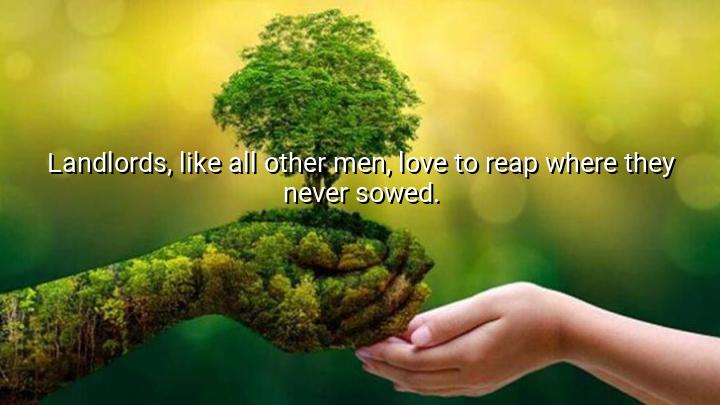




The quote by Karl Marx, "Landlords, like all other men, love to reap where they never sowed," reflects his critique of economic inequality and unearned wealth. Marx highlights the tendency of certain individuals, particularly landlords, to enjoy the benefits of others’ labor without contributing any effort themselves. The phrase “reap where they never sowed” metaphorically illustrates the exploitation inherent in systems where wealth or profit is derived from ownership rather than productive work.
The origin of the quote comes from Marx’s broader analysis of class struggle and capitalist society. In his writings, Marx consistently examined the dynamics between those who own property or capital and those who must work to survive. By including the comparison to "all other men," he emphasizes that this desire to gain without effort is not limited to landlords alone, but can be observed in various forms of social and economic behavior.
At its core, the quote underscores the idea of exploitation and the moral critique of benefiting from others’ labor. Marx’s use of agricultural imagery, such as sowing and reaping, makes the concept tangible, showing how wealth and privilege are often harvested without the effort that sustains them. It also aligns with his broader philosophy advocating for a fair distribution of resources and a society where labor, not ownership, determines reward.
Ultimately, the quote serves as a reflection on human nature, social structures, and economic justice. Marx encourages readers to recognize and question the systems that allow certain individuals to profit disproportionately from the work of others, highlighting the need for equity and systemic change in the pursuit of a just society.
If you want, I can also create a condensed, punchy version suitable for quotes on social media with the keywords bolded for emphasis.

AAdministratorAdministrator
Welcome, honored guests. Please leave a comment, we will respond soon