

Knowledge of what is does not open the door directly to what should be.
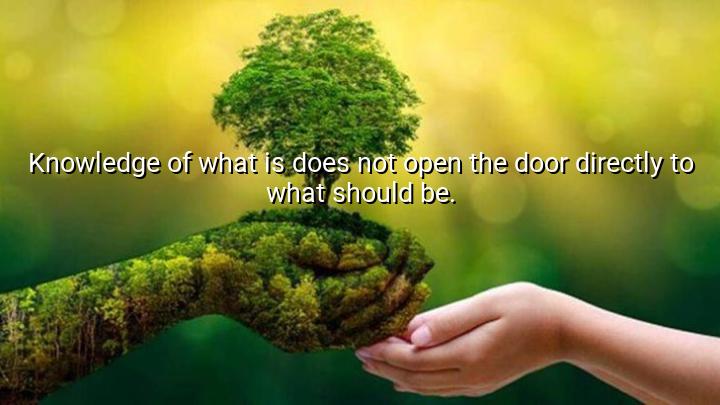




The quote, “Knowledge of what is does not open the door directly to what should be,” is attributed to Albert Einstein, one of the most influential physicists and thinkers of the 20th century. Known not only for his breakthroughs in theoretical physics but also for his reflections on philosophy and ethics, Einstein often emphasized the distinction between facts and values. This statement captures his recognition that while science and knowledge reveal the reality of the world, they do not, by themselves, determine the moral or ethical course of action humans should take.
The first part, “knowledge of what is,” refers to scientific facts, empirical observations, and objective truths about the universe. This includes everything from physical laws to social realities. For Einstein, science is powerful in describing and explaining what exists, but its scope is limited to the realm of what is, not to prescribing moral duties or values.
The second part, “does not open the door directly to what should be,” emphasizes the gap between descriptive knowledge and prescriptive action. Facts can inform decisions, but they cannot, on their own, dictate ethical choices. For example, knowing how nuclear power works does not answer whether it should be used for energy, medicine, or warfare. That leap requires values, morality, and human judgment, which exist beyond empirical science.
Ultimately, Einstein’s words remind us of the essential partnership between knowledge and ethics. While science gives us the tools to understand and transform the world, it is up to humanity to decide what should be—the purposes, values, and responsibilities guiding how knowledge is applied. This insight continues to shape debates in science, philosophy, and public policy today.

AAdministratorAdministrator
Welcome, honored guests. Please leave a comment, we will respond soon