

Knowledge of other people's beliefs and ways of thinking must be used to build bridges, not to create conflicts.
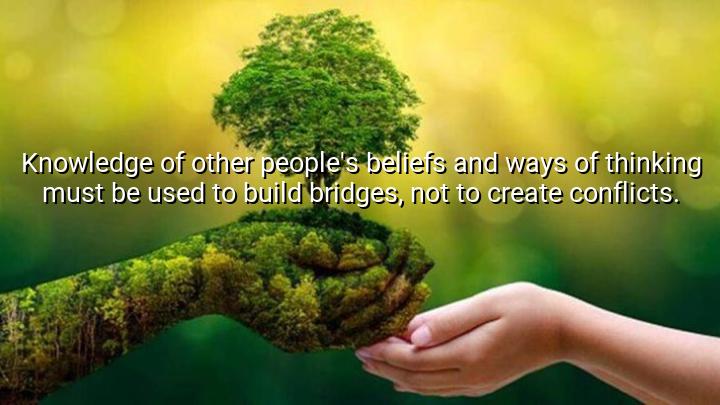




The quote by Kjell Magne Bondevik, "Knowledge of other people's beliefs and ways of thinking must be used to build bridges, not to create conflicts," emphasizes the ethical and constructive use of cultural and intellectual understanding. Bondevik argues that awareness of different perspectives should foster cooperation, empathy, and mutual respect, rather than serve as a tool to divide or dominate others.
By highlighting the importance of building bridges, Bondevik suggests that true knowledge carries a responsibility to promote dialogue and reconciliation. Understanding the beliefs and mental frameworks of others allows individuals and societies to navigate differences peacefully, encouraging collaboration and shared solutions rather than intensifying conflicts.
The origin of this quote comes from Bondevik’s experience as a Norwegian politician and former Prime Minister, as well as his work in promoting interfaith dialogue and peacebuilding. His perspective reflects his commitment to leveraging knowledge and cultural understanding to advance social cohesion, diplomacy, and global cooperation.
Ultimately, Bondevik’s statement underscores that knowledge is most valuable when applied ethically and constructively. It conveys that awareness of others’ thoughts and beliefs should serve as a foundation for unity, dialogue, and understanding, highlighting the moral responsibility that comes with the power of informed insight.

AAdministratorAdministrator
Welcome, honored guests. Please leave a comment, we will respond soon