

Knowledge is what we get when an observer, preferably a scientifically trained observer, provides us with a copy of reality that we can all recognize.
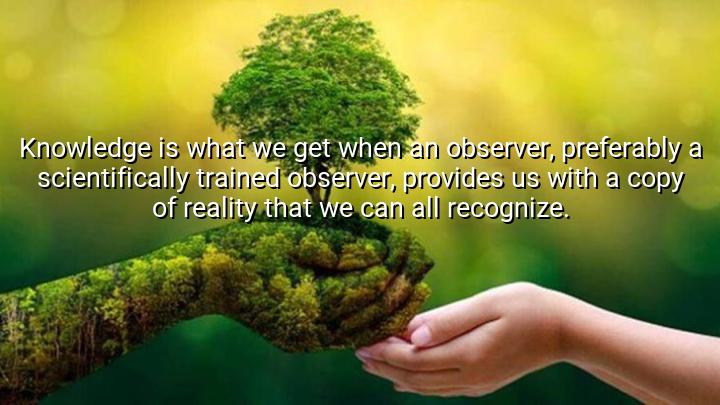




The quote by Christopher Lasch, "Knowledge is what we get when an observer, preferably a scientifically trained observer, provides us with a copy of reality that we can all recognize," emphasizes the importance of objective observation in the acquisition of knowledge. Lasch suggests that knowledge is reliable and meaningful when it is based on careful observation and documentation of reality, rather than subjective interpretation or speculation.
By highlighting the role of a scientifically trained observer, Lasch underscores the value of rigorous methodology and critical thinking in producing knowledge. The "copy of reality" refers to information that accurately represents the world and can be verified, shared, and understood by others, ensuring that knowledge is both credible and communal.
The origin of this quote comes from Lasch’s work as an American historian, social critic, and author, known for his examinations of culture, society, and intellectual life. His perspective reflects a commitment to empirical evidence and the principles of scientific inquiry, advocating for a clear distinction between mere opinion and verifiable knowledge.
Ultimately, Lasch’s statement conveys that knowledge is most valuable when it faithfully represents reality and can be universally recognized. It emphasizes that careful observation, critical analysis, and methodological rigor are essential for understanding the world, reinforcing the social and epistemological foundations of learning.

AAdministratorAdministrator
Welcome, honored guests. Please leave a comment, we will respond soon