

Knowledge is knowing that we cannot know.
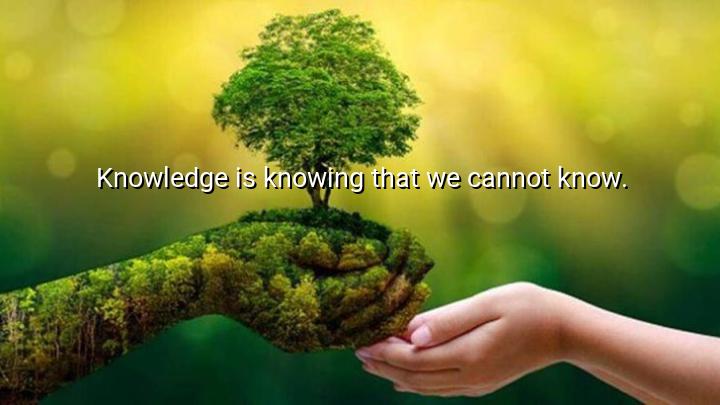




The quote, “Knowledge is knowing that we cannot know,” is attributed to Ralph Waldo Emerson, the 19th-century American essayist, philosopher, and leader of the Transcendentalist movement. Emerson often explored themes of self-reliance, nature, and the limits of human understanding. This statement reflects his recognition of the vastness of existence and the inherent limitations of human reason. True knowledge, in his view, begins with humility—the acceptance that our comprehension of the universe will always be incomplete.
The first part, “knowledge is knowing,” suggests that wisdom is not merely about accumulating facts or understanding concepts. Instead, it lies in self-awareness and intellectual honesty. Emerson is pointing out that the greatest thinkers are those who realize that certainty is elusive, and that life contains mysteries beyond the grasp of human logic.
The second part, “we cannot know,” underscores the boundaries of human inquiry. While science, philosophy, and experience expand our understanding, there will always remain truths that escape us. This resonates with both philosophical skepticism and spiritual humility, as Emerson often blended reason with a sense of the divine or transcendent. Recognizing these limits prevents arrogance and encourages a deeper sense of wonder.
Ultimately, Emerson’s words serve as a reminder that wisdom is not found in pretending to have all the answers but in acknowledging the vast unknown. By accepting the limits of human understanding, we cultivate curiosity, openness, and respect for mystery—qualities that deepen our intellectual and spiritual lives.

AAdministratorAdministrator
Welcome, honored guests. Please leave a comment, we will respond soon