

Knowledge is invariably a matter of degree: you cannot put your finger upon even the simplest datum and say this we know.
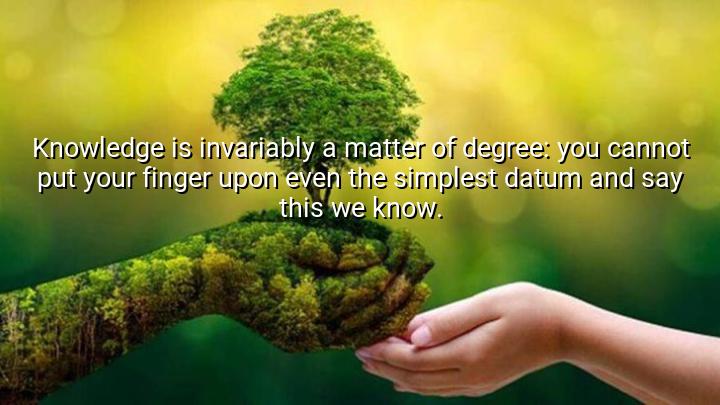




T. S. Eliot’s quote, "Knowledge is invariably a matter of degree: you cannot put your finger upon even the simplest datum and say this we know," reflects the complexity and nuance of knowledge. Eliot suggests that understanding is not absolute or fixed; rather, it exists on a spectrum. Even with the most basic information, one cannot claim to know everything with certainty because every piece of knowledge is subject to interpretation, context, and further discovery. The quote implies that our understanding of the world is always evolving and incomplete.
The origin of this quote lies in Eliot’s broader philosophy about human knowledge and the nature of truth. Known for his explorations of the limits of human understanding and the complexities of life, Eliot recognized that knowledge is never fully static. Instead, it is influenced by experience, perception, and ongoing learning. This perspective highlights the importance of humility in how we approach and interpret facts or data, as there is always more to uncover.
Eliot’s point also touches on the subjectivity of knowledge, suggesting that what we know is shaped by context and perspective. For example, the way we understand a particular datum can change depending on the frameworks we apply, such as cultural background, personal biases, or evolving scientific theories. Therefore, knowledge is not a simple matter of facts but is a layered and continuously shifting process that involves careful consideration and exploration.
Ultimately, the quote emphasizes the idea that knowledge is never absolute; it is always incomplete and evolving. Eliot encourages a deeper awareness of the complexities involved in understanding the world around us and reminds us that even the simplest facts are part of a larger, ongoing process of discovery and interpretation.

AAdministratorAdministrator
Welcome, honored guests. Please leave a comment, we will respond soon