

Just as your own existence is unlikely and far from inevitable, the evolution of modern humans as a species depended on a whole string of chance events - some happening in the environments our ancestors inhabited, and some inside their own bodies, including random mutations in their DNA.
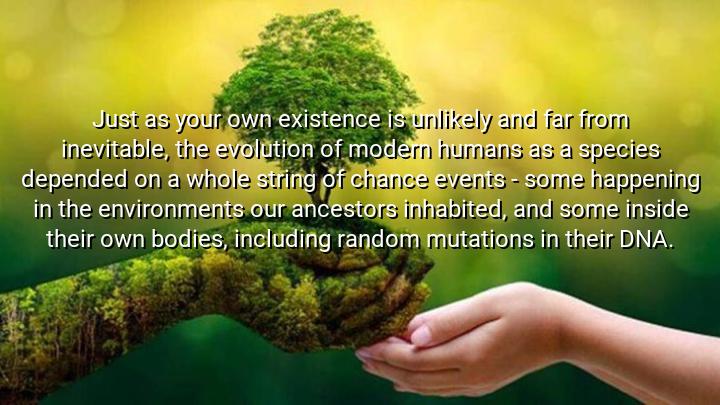




The quote by Alice Roberts emphasizes the role of chance and randomness in both individual existence and the evolution of modern humans. She points out that none of us are inevitable; our very presence is the result of countless unlikely events aligning over time. This applies not only to personal ancestry but also to the broader survival and development of the human species itself.
Roberts highlights that human evolution hinged on a string of chance events. Some of these occurred in the environments where our ancestors lived—such as climate changes, natural disasters, or migration patterns—while others took place within their bodies, such as random mutations in DNA. These mutations could influence traits, survival rates, and adaptability, eventually shaping the course of our species’ history.
The origin of this statement is grounded in Roberts’s work as a biological anthropologist and science communicator, where she often explores the interplay of science, history, and human origins. Her perspective draws on evolutionary biology, showing that while humans often seek meaning and patterns, much of life’s development is subject to chance rather than predetermined design.
By linking personal existence with the evolutionary journey of humankind, Roberts offers a humbling reminder: the fact that we are here at all is extraordinary. Our lives are not the product of inevitability, but of countless fragile coincidences, both external and internal, that could easily have gone another way. This view underscores the preciousness and rarity of human life.

AAdministratorAdministrator
Welcome, honored guests. Please leave a comment, we will respond soon