

Just as food eaten without appetite is a tedious nourishment, so does study without zeal damage the memory by not assimilating what it absorbs.
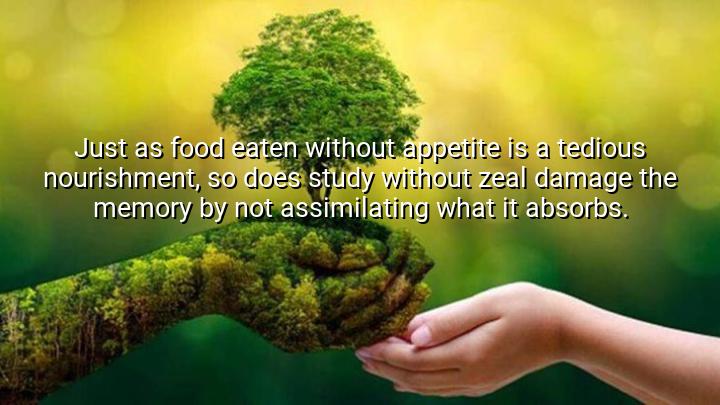




This quote by Leonardo da Vinci draws a vivid analogy between eating without appetite and studying without zeal. Da Vinci suggests that just as food consumed without hunger offers little satisfaction or benefit, knowledge pursued without passion fails to nourish the mind. Without enthusiasm, study becomes a mechanical process—lacking connection, depth, and retention. It’s a warning against rote learning and a reminder that true understanding requires engagement and curiosity.
The idea that zeal is essential to learning reflects Da Vinci’s own approach to knowledge and discovery. As a Renaissance polymath, he was deeply motivated by a natural sense of wonder and inquiry, exploring fields as varied as anatomy, engineering, and painting. His personal journals show a relentless pursuit of understanding driven by intrinsic motivation, not obligation. This quote likely stems from his reflections on how people learn—and fail to learn—effectively.
Furthermore, the phrase “damage the memory” emphasizes that disengaged study isn’t just ineffective—it’s counterproductive. The mind, like the body, must assimilate what it takes in, and without attention and interest, even the most valuable information can slip away. The metaphor paints the mind as a digestive system: it can only absorb what it’s ready and willing to process.
In sum, Da Vinci's quote advocates for passion-driven learning. It encourages learners to approach study with the same anticipation and desire as one would approach a satisfying meal. Only then can knowledge be fully internalized, become part of one's thinking, and contribute to real intellectual growth.

AAdministratorAdministrator
Welcome, honored guests. Please leave a comment, we will respond soon