

It's amazing how ideas start out, isn't it?
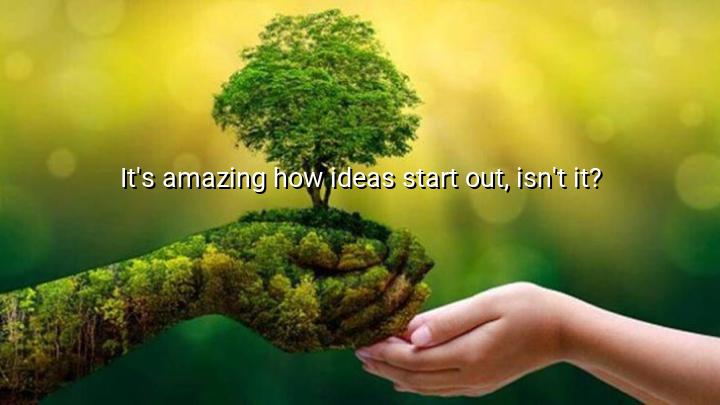




The quote by Nigel Farage — "It's amazing how ideas start out, isn't it?" — highlights the fascinating and often unpredictable nature of how ideas develop. Farage seems to express awe at the process of how simple thoughts or concepts can evolve into something much larger or more impactful. This quote reflects the creativity and potential of ideas, emphasizing how they can grow and transform, often in ways that are unexpected or surprising.
Farage’s statement also touches on the power of small beginnings. It suggests that ideas, no matter how modest at first, can lead to significant outcomes if nurtured and pursued with determination. Whether in politics, business, or art, many transformative changes start as simple thoughts, making it an exciting process to observe how these early seeds can blossom into something that shapes society or the world.
The origin of this quote is likely linked to Farage’s own experiences in politics and public life. As a British politician known for his leadership of the UK Independence Party (UKIP) and his strong views on Brexit, Farage has been involved in movements that began as niche or unconventional ideas but eventually gained traction on a national scale. His reflection on how ideas start out may be tied to his own journey of bringing political ideologies to the forefront, starting from the ground up.
Ultimately, Farage’s words remind us of the power of ideas and their ability to spark change. The development of any significant movement or innovation often begins with a single thought, and the process of exploration and growth is what makes it so amazing. Farage’s quote captures the excitement and potential that lies in the early stages of ideas, making us appreciate the value of creativity in shaping the future.

TNTuyen Nguyen
What struck me about this quote is the implicit question of ownership and evolution. An idea might begin in one person’s mind but grow through collaboration, opposition, or reinterpretation. Does the original thinker always deserve credit? Or do ideas belong to the collective once they’re shared? I’d love to hear a broader perspective on how society handles the origin and trajectory of ideas.
TDThi Tham Doan
It’s a simple statement, but it opens a huge philosophical door. Where do ideas come from? Are they truly original, or are they just recombinations of past thoughts and influences? And why do some people seem to have them constantly, while others struggle? This quote makes me curious about the psychology and neuroscience of idea formation and what conditions actually help new thoughts emerge.
LLinhvo
I like the subtle wonder in this quote. It's like a nod to the mystery of creativity itself. One moment you're thinking about a small problem, and the next, you’ve mapped out an entire project or philosophy. But I also think we sometimes romanticize ideas and forget how much hard work it takes to bring them to life. How do we balance inspiration with execution?
QDBui Quang Dang
There’s a poetic truth here. So much of what we take for granted—our technology, our laws, our beliefs—originated from someone’s imagination. What fascinates me is the unpredictability of ideas: some die out quickly, others evolve into powerful movements. Do you think we can ever predict which idea will survive and grow, or is it all just a mix of timing, context, and persistence?
THNguyen Thanh Hung
Honestly, I find this quote a bit too vague. Sure, ideas are amazing in their evolution, but shouldn’t we also consider how some ideas—especially when poorly thought out or rooted in divisiveness—can become dangerous? I’d be curious to know if Farage was referencing a specific idea or movement here. What kind of 'start' is he marveling at: a spontaneous thought, a political shift, or a personal realization?