

It took the madmen of yesterday for us to be able to act with extreme clarity today. I want to be one of those madmen. We must dare to invent the future.
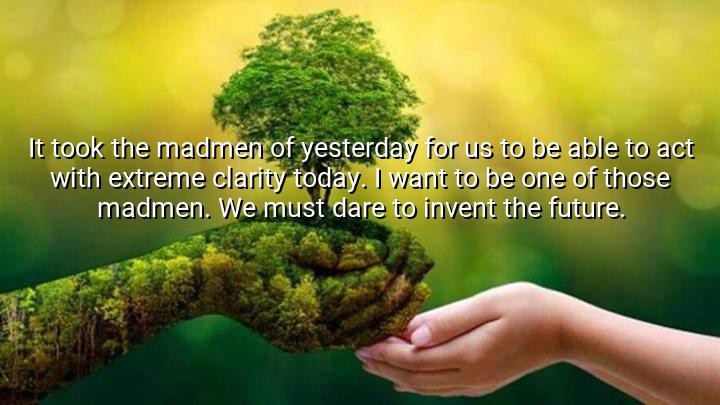




Thomas Sankara's quote, "It took the madmen of yesterday for us to be able to act with extreme clarity today. I want to be one of those madmen. We must dare to invent the future," speaks to the revolutionary mindset required to challenge the status quo and create lasting change. Sankara is acknowledging that those who are often viewed as radicals or visionaries—the "madmen"—are the ones who pave the way for future progress. By acting outside the norms of their time, they lay the groundwork for others to build upon with greater clarity and purpose.
The origin of this quote is rooted in Sankara's leadership in Burkina Faso, where he led a revolutionary government that sought to bring social, political, and economic reforms to the country in the 1980s. Sankara’s policies were seen as radical at the time, as he advocated for land redistribution, women’s rights, and a rejection of colonial influence. By calling himself one of the "madmen," he aligned himself with those who dared to challenge established systems and take risks for the sake of creating a better future.
The idea of daring to invent the future reflects Sankara’s belief in the power of imagination and action to shape a new world. He believed that true change comes from those willing to think beyond the limitations of the present and act with a vision for a better tomorrow. Sankara’s desire to be a "madman" is a call for boldness and the courage to defy convention in the pursuit of progress. It is a reminder that innovation often requires risk, and that sometimes it takes those who are willing to be unconventional to bring about meaningful transformation.
Ultimately, this quote underscores the importance of vision and courage in shaping the future. Sankara challenges us to embrace the spirit of the "madmen"—those who dared to take risks, think differently, and act decisively—so that we can invent a future that is just, equitable, and progressive. Through this mindset, Sankara encourages future generations to boldly challenge the status quo and create the world they wish to see.

AAdministratorAdministrator
Welcome, honored guests. Please leave a comment, we will respond soon