

It is not possible to design always the same. How to be different in each different place - that is the most important work and duty of the architect to find out.
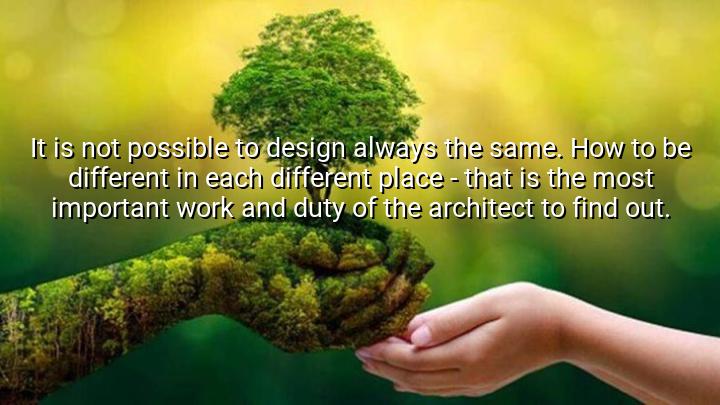




Jean Nouvel’s quote, “It is not possible to design always the same. How to be different in each different place—that is the most important work and duty of the architect to find out,” highlights the importance of contextual design in architecture. He argues that buildings should not be repetitive or uniform but should respond uniquely to the place, culture, and environment in which they are built.
The meaning of this statement lies in Nouvel’s philosophy that architecture must be rooted in its surroundings rather than imposed as a one-size-fits-all solution. For him, the architect carries the responsibility to adapt each project to its location, taking into account history, climate, landscape, and the human experience. This ensures that the design is not only functional but also meaningful and relevant to the community it serves.
The origin of this idea can be seen throughout Nouvel’s career, as he became known for his highly individualized projects such as the Institut du Monde Arabe in Paris and Torre Agbar in Barcelona. Instead of developing a single recognizable style, he embraced diversity in his work, letting each design emerge from the identity of the place itself. This approach set him apart from architects who prioritize a personal signature style over contextual sensitivity.
Ultimately, the quote underscores Nouvel’s belief that the duty of the architect is to uncover what makes a place unique and to reflect that uniqueness in their design. By resisting uniformity and embracing difference, architecture becomes not only a physical structure but also a cultural statement that enriches both the place and the people who inhabit it.

AAdministratorAdministrator
Welcome, honored guests. Please leave a comment, we will respond soon