

Isn't it amazing the way the future succeeds in creating an appropriate past?
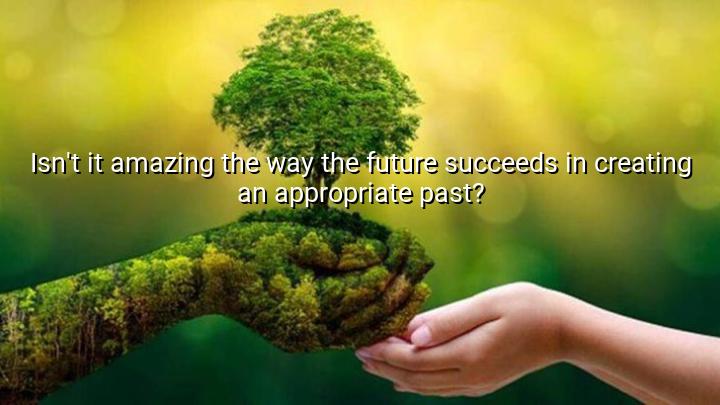




The quote by John Leonard — "Isn't it amazing the way the future succeeds in creating an appropriate past?" — reflects the intriguing relationship between time, memory, and perspective. Leonard suggests that the events of the future shape how we perceive and interpret the past. As time progresses, our understanding of past events often changes in light of new experiences or information, making it seem as though the future has a hand in defining what is remembered or how it's remembered.
Leonard’s statement speaks to the fluidity of memory and how our understanding of history is not fixed but often influenced by current events and perspectives. The quote implies that the way we look back on the past can evolve, sometimes in ways that make it appear more aligned with what has unfolded in the future. This highlights the dynamic nature of how we view our own lives, historical events, and collective memories over time.
The origin of the quote comes from Leonard’s reflection on the human tendency to reinterpret the past in light of present circumstances. As a writer and critic, Leonard often explored the nature of memory and the way culture and history are shaped. His insight into the shifting nature of how we understand the past suggests that our perceptions are constantly being reshaped by what comes next.
Ultimately, Leonard’s words encourage us to recognize that history is not static, and our understanding of it is shaped by the lens of the future. The quote serves as a reminder that our interpretations of the past are often revised as new information or perspectives emerge, making it amazing how our experiences and the flow of time can alter what we once thought was fixed.

NT36. Dang Tran Ngoc Tram
This quote makes me think of how historical revisionism works—sometimes for better understanding, sometimes for manipulation. Do we really change the past, or just the story we tell about it? It's a complex idea, especially when considering cultural trauma or national pride. Who gets to decide which version of the past becomes ‘appropriate’ in the eyes of the future?
NMVy - 9/2 Nguyen Ngoc Minh
It’s fascinating how we tend to ‘tidy up’ the past once we know how things turn out. Failures are reframed as lessons, pain becomes growth, and everything seems to fit a story arc in hindsight. But is that just a coping mechanism? Or a way to create meaning out of chaos? I wonder how different our memories would be if we didn’t know how the story ends.
TDTruc Diem
This is such a poetic take on the relationship between time and memory. I see it as a reminder that memory isn’t fixed—it morphs to align with our current identity or beliefs. But isn’t that a bit dangerous? If we let the future color the past too much, do we risk losing an honest account of what really happened? How do we balance narrative with truth?
TLPhan Thi Tuong Linh
What a provocative statement! It makes me ask: are we guilty of selectively remembering history to suit current narratives? Governments, institutions, even individuals tend to revise or reinterpret past events based on present values or agendas. I’d love to explore how this phenomenon shows up in education, media, or even personal memory. How do we guard against a distorted past when it’s so tempting to reshape it?
TDAnh Tuyet Dao
This quote really got me thinking—does it mean that we reinterpret the past through the lens of the present to justify where we’ve ended up? It’s like history is constantly being rewritten not factually, but in terms of what we emphasize or ignore. I wonder how much of what we accept as ‘true’ about the past is actually shaped by what the future needs it to be.