

Is it right to probe so deeply into Nature's secrets? The question must here be raised whether it will benefit mankind, or whether the knowledge will be harmful.
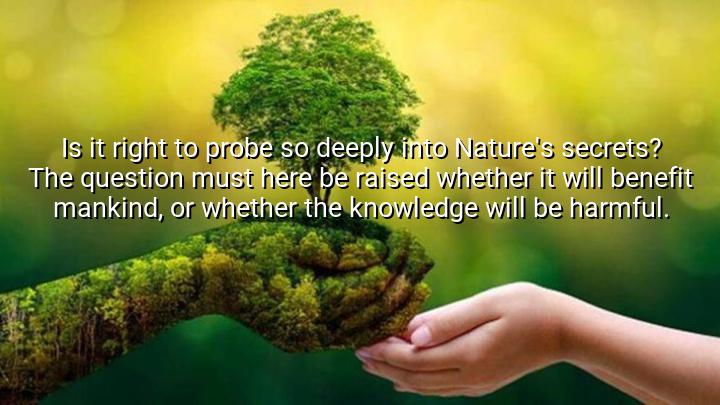




The quote “Is it right to probe so deeply into Nature's secrets? The question must here be raised whether it will benefit mankind, or whether the knowledge will be harmful.” by Pierre Curie expresses a profound ethical concern about the pursuit of scientific knowledge. Curie acknowledges the power of science to uncover Nature’s secrets, but he also warns that such discoveries can have dual consequences—offering potential benefits to humanity or causing harm if misused. His words reflect the timeless dilemma of scientific progress: whether knowledge itself is neutral and only its application determines its impact.
The origin of this statement comes from Curie’s reflections during his groundbreaking research in radioactivity alongside his wife, Marie Curie. Their work led to monumental scientific discoveries, but also carried unforeseen dangers. Pierre Curie, aware of the power and risks of radiation, foresaw that scientific advances could be used for both constructive purposes—such as medicine—and destructive ones, including weapons. His caution reveals a scientist deeply concerned with the moral responsibility of discovery.
The meaning of the quote is that the pursuit of knowledge cannot be separated from questions of ethics. Scientific curiosity is natural and valuable, but Curie insists that humanity must continually ask whether each breakthrough will ultimately serve the greater good or bring about new forms of suffering. This tension reminds us that unchecked ambition in science can have unintended consequences, and that responsibility must accompany exploration.
Ultimately, Curie’s words remain strikingly relevant in debates about modern science and technology—whether in nuclear energy, artificial intelligence, or biotechnology. By questioning the value and consequences of delving too deeply into Nature’s mysteries, he highlights the need for balance between discovery and wisdom. His statement stands as both a recognition of science’s potential and a warning about its dangers if pursued without ethical reflection.

AAdministratorAdministrator
Welcome, honored guests. Please leave a comment, we will respond soon