

In these troubled, uncertain times, we don't need more command and control; we need better means to engage everyone's intelligence in solving challenges and crises as they arise.
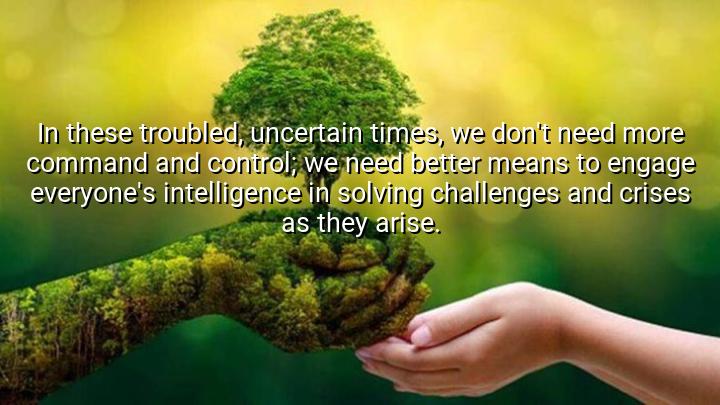




In this quote, Margaret J. Wheatley emphasizes the need for a shift away from traditional command and control leadership structures in times of crisis. She argues that in the face of troubled, uncertain times, what is truly needed is not top-down authority, but more effective ways to engage the intelligence of everyone involved. Wheatley suggests that the collective knowledge, creativity, and problem-solving abilities of all individuals are essential in addressing the challenges and crises that arise, rather than relying on centralized decision-making that may be too slow or out of touch.
Wheatley’s statement highlights the importance of collaboration and shared leadership in complex situations. Instead of having a few leaders dictate responses, she advocates for involving all members of a group or organization in the decision-making process. By tapping into the diverse intelligences of the entire team, organizations can be more adaptive and responsive, leading to more effective solutions when faced with difficult circumstances.
The origin of this quote comes from Margaret J. Wheatley, a renowned writer and speaker in the fields of organizational development and leadership. Wheatley is known for her work on leadership in the context of complexity and systems thinking. Throughout her career, she has focused on how organizations can better navigate change and uncertainty by fostering a culture of trust, collaboration, and shared responsibility, rather than relying on hierarchical structures.
In essence, Wheatley’s quote calls for a more democratic and intelligent approach to leadership, one that values the input of everyone, especially in times of crisis. She argues that true progress comes when individuals and groups work together, drawing on their collective intelligence to find creative solutions to the challenges they face. This mindset is essential for organizations and societies aiming to thrive in an increasingly unpredictable world.

AAdministratorAdministrator
Welcome, honored guests. Please leave a comment, we will respond soon