

In the United States alone, 450 billion square feet of glass facade is produced every year. What if we could take this chance to use the glass to harness solar energy and allow the architecture to respond to the light and heat of the sun, to create photosynthesis and generate solar energy?
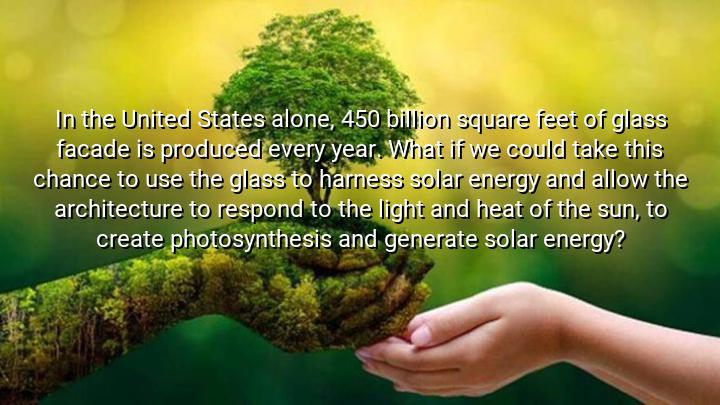




The quote by Neri Oxman — "In the United States alone, 450 billion square feet of glass facade is produced every year. What if we could take this chance to use the glass to harness solar energy and allow the architecture to respond to the light and heat of the sun, to create photosynthesis and generate solar energy?" — imagines a future where buildings not only shelter us but also interact symbiotically with the environment. Oxman, known for pioneering the field of Material Ecology, challenges traditional notions of passive architecture by proposing a vision in which buildings are active systems — capable of energy production, self-regulation, and even life-like behavior.
By referencing the vast quantity of glass facades produced annually in the U.S., Oxman highlights a missed opportunity: these surfaces are typically underutilized in terms of their functional potential. She proposes a shift from glass as a mere aesthetic and structural material to a bio-integrated medium that can collect solar energy, regulate temperature, and even engage in processes like photosynthesis, mimicking nature to create buildings that sustain and energize themselves.
The quote also reflects Oxman’s belief in interdisciplinary design, where biology, technology, and architecture merge to form a new paradigm of sustainable innovation. Her suggestion to use architectural materials in this responsive and regenerative way speaks to her broader mission of developing structures that evolve, adapt, and coexist with the natural world — rather than depleting it. This vision moves beyond green architecture to living architecture, where the built environment becomes a partner in the planet’s ecology.
The origin of this quote likely comes from Oxman's lectures or writings where she explores the potential of next-generation materials and building technologies. As a former professor at the MIT Media Lab and founder of The Mediated Matter Group, she has consistently pushed the boundaries of how we think about materials and the role of design in shaping the future. This quote encapsulates her radical yet deeply thoughtful vision of architecture as an ecological force, one that transforms buildings into producers of energy and life.

AAdministratorAdministrator
Welcome, honored guests. Please leave a comment, we will respond soon