

In the real world, 90% of the money spent on medical research is focused on conditions that are responsible for just 10% of the deaths and disability caused by diseases globally.
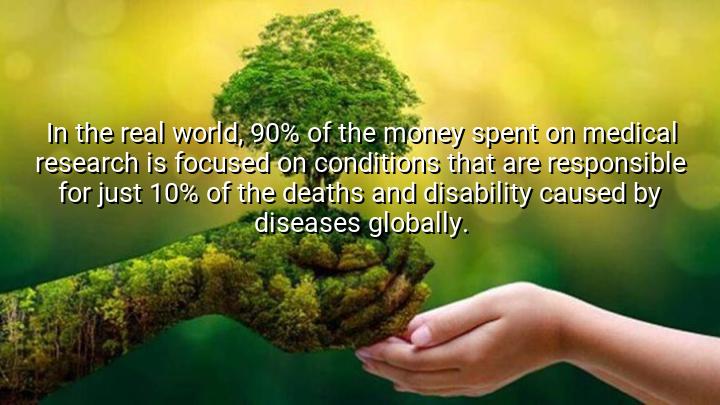




The quote by Peter Singer, “In the real world, 90% of the money spent on medical research is focused on conditions that are responsible for just 10% of the deaths and disability caused by diseases globally,” highlights a significant imbalance in the allocation of medical research funding. Singer draws attention to the disproportion between the resources invested and the actual global health burden. This suggests that many serious health challenges, particularly those affecting low-income populations, receive far less attention and funding than wealthier-market diseases.
The origin of the quote comes from Singer’s work as a philosopher and ethicist, particularly in the fields of bioethics and global health ethics. He often examines how societal priorities and economic incentives shape decision-making in healthcare and research. By citing this statistic, Singer critiques the market-driven approach to research funding, emphasizing that it does not always align with moral responsibility or the goal of reducing human suffering on a global scale.
This statement also points to the concept of the “10/90 gap”, a well-known issue in global health policy where the majority of research resources target problems prevalent in wealthy countries, while diseases that cause the most deaths and disability worldwide are underfunded. Singer’s observation urges a reconsideration of ethical priorities, calling for more equitable distribution of research efforts so that preventable suffering can be addressed more effectively.
Ultimately, the quote is both a critique and a call to action. It challenges policymakers, researchers, and the public to think about the ethics of funding and the social responsibility of the medical community. By highlighting this disparity, Singer encourages a shift toward research that aligns resources with the actual global health burden, promoting a more just and effective approach to improving human well-being worldwide.

AAdministratorAdministrator
Welcome, honored guests. Please leave a comment, we will respond soon