

In the 20th century, we had a century where at the beginning of the century, most of the world was agricultural and industry was very primitive. At the end of that century, we had men in orbit, we had been to the moon, we had people with cell phones and colour televisions and the Internet and amazing medical technology of all kinds.
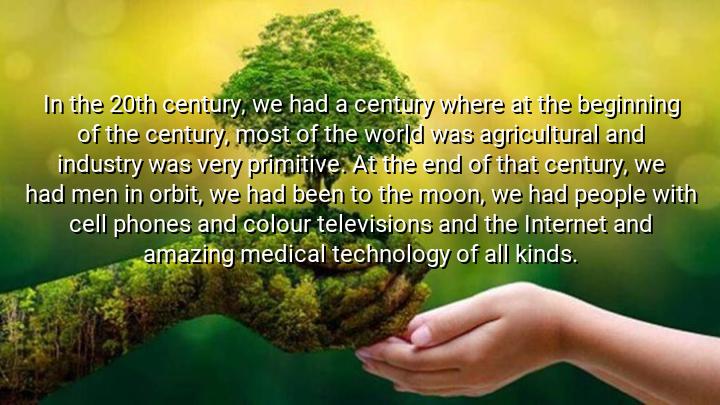




The quote "In the 20th century, we had a century where at the beginning of the century, most of the world was agricultural and industry was very primitive. At the end of that century, we had men in orbit, we had been to the moon, we had people with cell phones and colour televisions and the Internet and amazing medical technology of all kinds." by David Gerrold reflects on the incredible advancements in technology, science, and human progress that occurred over the course of the 20th century. Gerrold highlights the stark contrast between the early 1900s, when much of the world was still agricultural and industry was relatively basic, and the later part of the century, which saw major milestones in space exploration, communication, and medicine.
David Gerrold, a science fiction writer and author, often explores themes of technological growth and the potential of humanity in his work. In this quote, he emphasizes the rapid technological progress that took place, showcasing significant achievements like space exploration, the moon landing, the rise of cell phones, the development of color televisions, the creation of the Internet, and advancements in medical technology. These developments transformed daily life and the way people connected with one another, marking a pivotal era of innovation and discovery.
The origin of this quote stems from Gerrold's reflections on the 20th century, which was marked by rapid scientific and technological breakthroughs. As a writer deeply fascinated by science and the future, Gerrold often discusses the impact of these changes on society and the individual. His words emphasize how the 20th century was a defining period in human history, where progress in areas like communication, transportation, and healthcare changed the course of civilization.
Ultimately, Gerrold’s quote speaks to the dramatic shift in the world that took place during the 20th century. It highlights how, in just one hundred years, humanity moved from a largely agrarian society to one of space exploration and technological wonders. This rapid pace of change underscores the incredible potential of human ingenuity and innovation, inspiring future generations to continue pushing the boundaries of what is possible.

PTNguyen Phuong Tra
This quote really puts things in perspective. The 20th century feels like it could be one of the most revolutionary periods in human history. But do you think we truly understand how to use the technologies and breakthroughs we’ve developed? It seems like we create faster than we can ethically or socially adapt. How do we ensure future innovation doesn’t outpace our ability to manage its consequences?
G5luffy gear 5
It’s fascinating to look back and see how far we came in such a short span of time. But I can’t help but wonder—will the 21st century bring the same kind of leap forward, or have we lost some of that momentum? With all the innovation fatigue and political division, do we still have the unity or drive to make another century as transformative?
T743 Nguyen Ngoc Minh Tri 7/4
I love how this quote paints a vivid picture of transformation—it’s inspiring. But it also makes me wonder: with all these advancements, have we really improved the human condition equally across the globe? There’s still so much inequality, lack of access to healthcare, and digital divides. Are we really progressing as a species, or are we just advancing in isolated pockets?
MATran Minh Anh
Reading this makes me feel both awestruck and curious. How did humanity manage to leap so far, so fast? Was it simply technological momentum, or was there something about the human spirit and ambition during that time that made it possible? And now that we’re in the 21st century, are we still on a similar trajectory, or have we hit a kind of innovation plateau?
AA05 Acc ao
This quote really made me pause and appreciate how much progress was packed into just one century. It’s mind-blowing. But I also wonder—did we pay a price for that rapid advancement? Industrialization, while incredible, also led to environmental damage, wars with devastating technologies, and social disruptions. Do you think the pace of innovation in the 20th century came at the cost of something equally important, like sustainability or ethics?