

In photography, the smallest thing can be a great subject. The little, human detail can become a Leitmotiv.
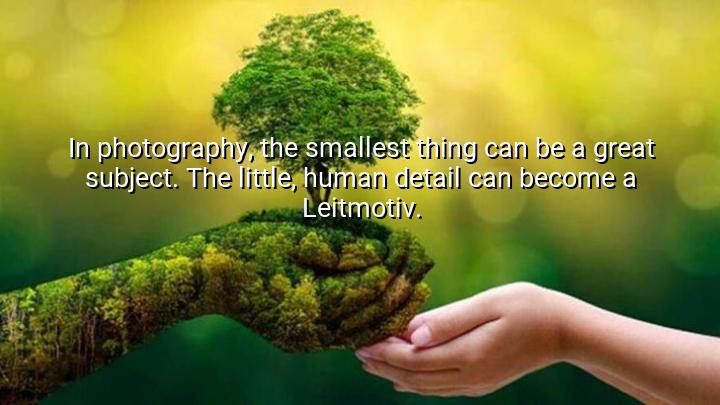




In this quote, Henri Cartier-Bresson, a renowned photographer, emphasizes that even the smallest things can hold great significance in photography. He suggests that often the most simple details, particularly those related to human interaction or emotion, can be powerful subjects for a photograph. These seemingly insignificant moments or details can reveal deeper truths about life and become central themes, or Leitmotivs, in a series of images. Cartier-Bresson’s perspective encourages photographers to pay attention to the subtleties and nuances that might otherwise be overlooked.
Cartier-Bresson’s reference to the Leitmotiv—a recurring theme in literature or music—suggests that these small, human moments can take on a symbolic role, becoming the heart of a larger narrative within a body of work. The idea that a detail can transcend its simplicity and become a central motif reflects the power of observation and composition in photography. It invites photographers to find meaning in the seemingly mundane, using these moments to tell a richer, more evocative story.
The origin of the quote comes from Henri Cartier-Bresson, a French photographer considered one of the pioneers of photojournalism. His work focused on capturing fleeting moments of human emotion and everyday life, believing that a single image could encapsulate profound meaning. His philosophy was rooted in the idea that the most important moments in life were often the most subtle, and his ability to capture those moments helped define the genre of street photography.
Ultimately, this quote highlights the idea that photography is not only about grand scenes or dramatic subjects, but also about appreciating the small details that reveal the essence of the human experience. Cartier-Bresson’s words remind photographers to look closely at the world around them, as even the tiniest, most ordinary details can carry great emotional or narrative weight.

AAdministratorAdministrator
Welcome, honored guests. Please leave a comment, we will respond soon