

In order to deal with all the medical cost demands and other challenges in the U.S., as we look to raise that revenue, the rich will have to pay slightly more. That's quite clear.
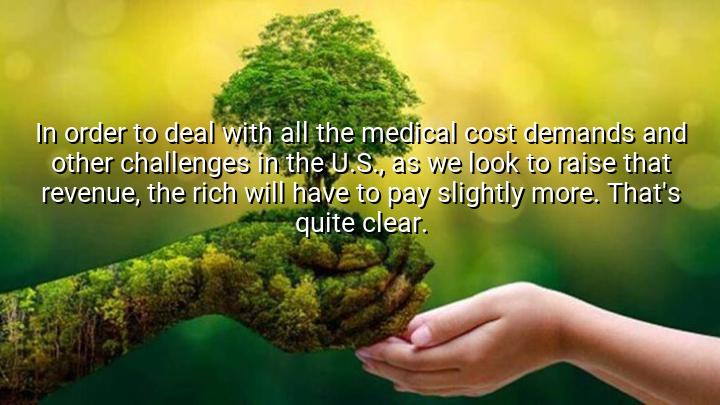




In this quote, Bill Gates addresses the issue of rising medical costs and other financial challenges facing the United States. He suggests that in order to meet these demands, there must be a way to raise revenue to support necessary services and infrastructure. Gates points out that one solution to this problem is for the rich to contribute more financially, indicating that the wealthy should pay slightly more in taxes to help alleviate the financial burdens on the country, particularly in areas like healthcare.
Gates' statement is rooted in his long-standing belief in the importance of progressive taxation, where those with greater financial resources contribute a higher share of their income to the public good. This notion reflects his advocacy for economic equity and his support for funding public services through taxes. He is acknowledging the necessity of addressing income inequality, particularly in the face of challenges like the skyrocketing costs of healthcare and other social programs.
The origin of the quote stems from Gates' views on philanthropy and his role as a public figure deeply involved in efforts to tackle global issues, including poverty, healthcare access, and education. As co-founder of Microsoft and later a leading philanthropist through the Bill & Melinda Gates Foundation, he has often spoken about the need for systemic change to address large-scale issues, including the economic pressures faced by the U.S. due to rising healthcare expenses.
Ultimately, Gates is stressing the importance of addressing the financial gap between the rich and the poor in a country like the U.S., where income inequality remains a significant concern. His suggestion that the rich pay more is a call to action for those with the means to help support a more equitable society. This quote highlights the broader conversation about how to fairly distribute the costs of essential services and support a more sustainable, inclusive future.

AAdministratorAdministrator
Welcome, honored guests. Please leave a comment, we will respond soon