

In faith there is enough light for those who want to believe and enough shadows to blind those who don't.
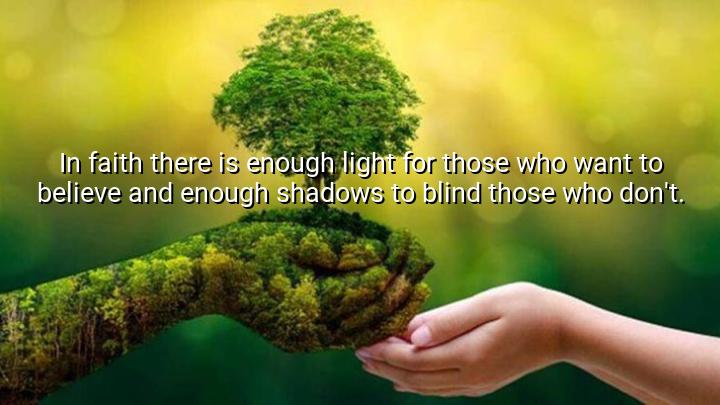




The quote by Blaise Pascal — “In faith there is enough light for those who want to believe and enough shadows to blind those who don't” — explores the dual nature of faith as both enlightening and elusive. Pascal suggests that faith provides clarity and understanding to those who are open and willing to believe. For these individuals, faith acts as a source of light, guiding and illuminating their spiritual journey.
However, the quote also acknowledges that faith contains enough ambiguity or “shadows” to remain hidden or inaccessible to those who are skeptical or unwilling to believe. These shadows symbolize doubt and uncertainty, which can obscure the truth of faith for some people. Pascal highlights that the perception of faith depends largely on one's attitude and openness toward belief.
The origin of this quote comes from Blaise Pascal, a 17th-century French mathematician, philosopher, and theologian. Pascal was deeply interested in the relationship between reason and faith, famously developing “Pascal’s Wager” as an argument for belief in God. His writings often address the complexities and mysteries of faith and human understanding.
In essence, this quote teaches that faith is a personal and subjective experience, shaped by one’s willingness to embrace it. It reminds us that faith can be a powerful source of light for believers while remaining obscured to those who resist or reject it.

AAdministratorAdministrator
Welcome, honored guests. Please leave a comment, we will respond soon