

In books, as in life, there are no second chances. On second thought: it's the next work, still to be written, that offers the second chance.
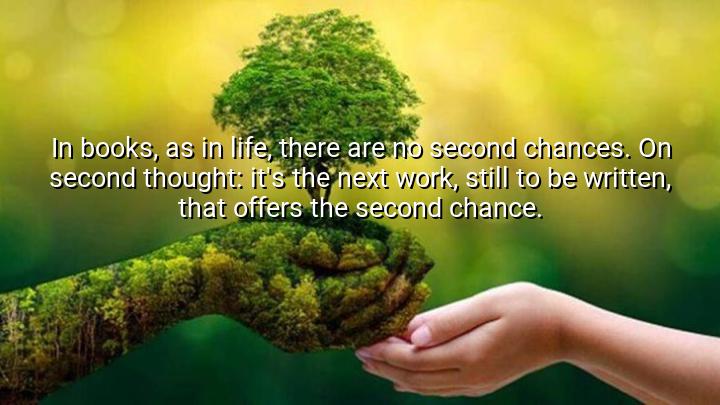




The quote "In books, as in life, there are no second chances. On second thought: it's the next work, still to be written, that offers the second chance" by Cynthia Ozick reflects on the irreversible nature of decisions and actions, both in literature and in life. Ozick first suggests that once something is written or done, it cannot be undone—there are no second chances to change or correct it. This is particularly true for books, where every word and decision made by the author is final, just like life, where we cannot go back and rewrite our past actions.
However, Ozick revises this thought with a sense of hope and possibility, acknowledging that while there may be no second chances for past works or actions, the future holds new opportunities. The next work, whether it's another book or the continuation of life, offers a second chance. This emphasizes the power of renewal and the opportunity to create again, to improve, and to try once more. The "next work" symbolizes hope, growth, and the potential to make things right or different in the future.
The origin of this quote can be traced to Ozick’s perspective as a writer and novelist. As a literary figure, she has often explored themes of memory, identity, and regret in her work. This quote reflects her understanding of both the creative process and the human experience. In literature, as in life, the act of creation is irreversible, but it is also a continual process where one work leads to the next, and the chance for improvement and reinvention is always just ahead.
Ultimately, Ozick’s quote serves as a reminder that while the past may be unchangeable, the future is filled with the potential for new beginnings. It encourages embracing second chances not in terms of revisiting past mistakes but in future endeavors—the next book, the next opportunity, and the next phase of life. This perspective offers a sense of hope and the freedom to continue growing, learning, and creating.

AAdministratorAdministrator
Welcome, honored guests. Please leave a comment, we will respond soon