

In any food crisis, it is the top of the food chain that suffers the most. In the case of farmer's distress, the top of food chain is us - the end consumer.
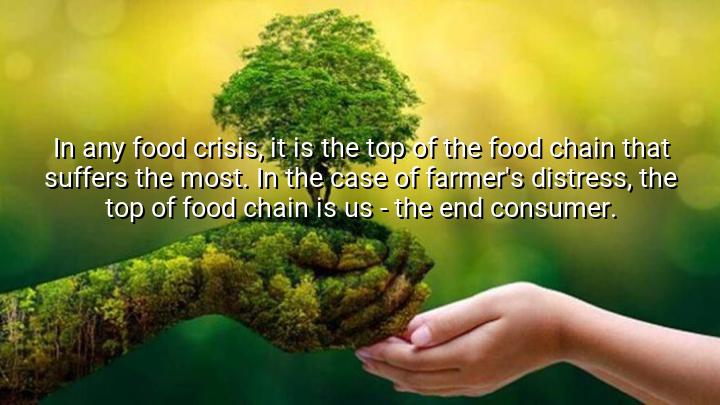




The quote "In any food crisis, it is the top of the food chain that suffers the most. In the case of farmer's distress, the top of food chain is us – the end consumer." by Prashant Bhushan, a prominent Indian lawyer, activist, and social commentator, presents a thought-provoking reversal of common assumptions about food systems. It underscores the interconnectedness between farmers, who are at the base of food production, and consumers, who sit at the top of the food chain. Bhushan’s insight highlights that agricultural distress, though it may begin at the bottom, eventually leads to serious consequences for society at large, particularly for the end consumer.
This quote draws attention to the fact that when farmers face challenges such as low crop prices, debt, climate shocks, or lack of support, it disrupts the entire food supply chain. Initially, it may seem like only rural communities are affected, but over time, food scarcity, price inflation, and reduced quality trickle upward to impact those who rely on steady access to food—namely, the urban consumers and larger populations. Bhushan reframes the idea of vulnerability, showing that a crisis at the bottom of the chain can cause significant damage at the top.
The origin of this quote likely stems from Bhushan’s advocacy work focused on agrarian justice and economic equity in India. His legal and social efforts often champion the rights of marginalized groups, including smallholder farmers, whose struggles are frequently overlooked despite their central role in sustaining the nation’s food economy. This quote reflects a broader push to make people recognize the invisible dependencies that urban lifestyles have on rural labor and resilience.
Ultimately, Bhushan’s message is a call for awareness and responsibility. By recognizing that the end consumer is directly affected by farmer distress, he urges policymakers and citizens to support sustainable agricultural systems, fair pricing, and rural development. In doing so, we not only help farmers—but also protect our own food security and well-being.

AAdministratorAdministrator
Welcome, honored guests. Please leave a comment, we will respond soon