

In an economy, when the government spends more and invests in the economy, that money circulates, and recirculates again and again. So not only does it create jobs once: the investment creates jobs multiple times.
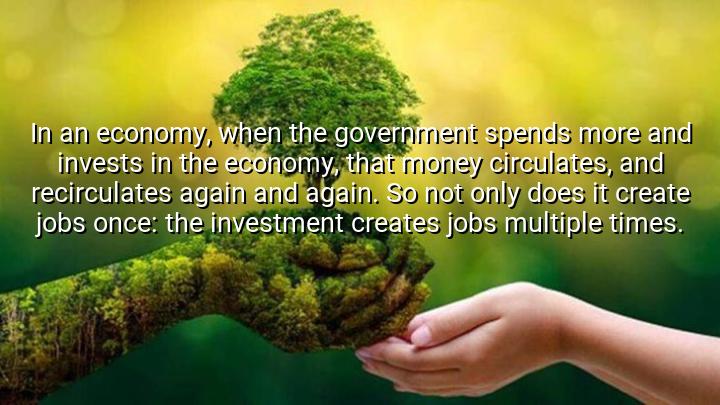




Joseph Stiglitz's quote emphasizes the concept of the multiplier effect in economics. He suggests that when the government spends money and invests in the economy, that investment doesn't just create immediate jobs; it also circulates through the economy, generating additional economic activity. This means that the initial spending by the government results in a chain reaction where the money is spent, earned, and spent again, creating multiple opportunities for job creation and economic growth. Stiglitz highlights the cyclical nature of economic investment, where the benefits compound over time.
The idea that investment "recirculates again and again" reflects the dynamic process by which money flows through different sectors of the economy. As the government invests in infrastructure, education, or other public services, the individuals who are employed as a result of this spending will spend their earnings on goods and services, which in turn creates more demand and more jobs. Stiglitz is emphasizing that the impact of government investment isn't just a one-time event but has long-lasting effects on the economy.
In this view, government spending isn’t just a cost; it’s a form of economic stimulus that can generate sustained growth. By increasing the amount of money in circulation, the government can spur economic activity across various sectors, helping to stabilize and grow the economy. Stiglitz's perspective is particularly relevant when considering recessionary periods, where government investment can help offset a decline in private sector spending.
Ultimately, Stiglitz’s quote highlights the importance of public investment in driving economic recovery and long-term growth. His argument is that government spending, when strategically directed, does more than simply create jobs in the short term—it sets off a positive feedback loop that continues to benefit the economy long after the initial investment.

AAdministratorAdministrator
Welcome, honored guests. Please leave a comment, we will respond soon