

In a home school, the kid does 95% of the work. But in a school system, since it's an indoctrination system, a teacher has to do 95% of the work.
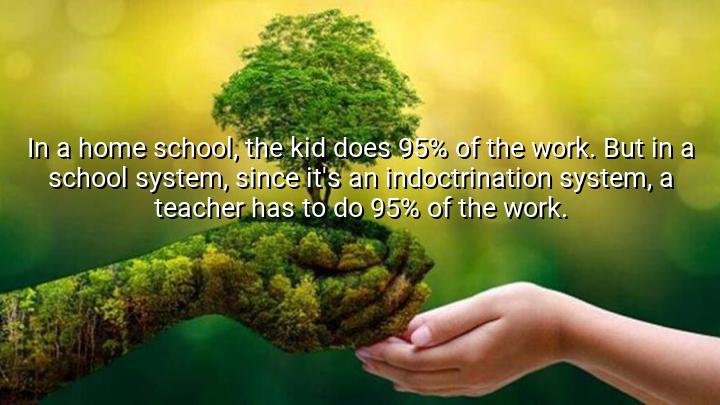




In this quote, John Taylor Gatto, a former teacher and education critic, contrasts the learning experiences in a home school environment versus a traditional school system. He argues that in a home school, the student is more self-driven and responsible for much of their own learning, completing around 95% of the work. This suggests that homeschooling encourages independence, critical thinking, and personal responsibility, where the student actively engages with the material and takes charge of their education.
On the other hand, Gatto critiques the school system, claiming that it functions more as an indoctrination system rather than a place for independent thought or creativity. In his view, teachers in traditional schools do the majority of the work—95%—by directing the curriculum, managing classroom behavior, and guiding students through a structured, often rigid system. Gatto's use of the term "indoctrination" implies that the traditional school system often prioritizes conformity, obedience, and the absorption of standardized knowledge, rather than fostering independent thought and inquiry.
The quote reflects Gatto's philosophical views on the shortcomings of the modern education system. He was known for his outspoken criticism of compulsory schooling, believing that it stifled creativity and personal growth. By emphasizing the contrast between home education and institutionalized schooling, Gatto suggests that the latter often creates passive learners who depend on external guidance rather than developing the skills necessary to learn independently.
The origin of this quote comes from Gatto’s extensive critique of the American education system, particularly in his book Dumbing Us Down: The Hidden Curriculum of Compulsory Schooling. Throughout his career, Gatto argued that the traditional school system often undermines students' natural curiosity and independence. His work sparked significant debates about education reform, questioning the role of schools in shaping individuals' ability to think critically and act autonomously.

AAdministratorAdministrator
Welcome, honored guests. Please leave a comment, we will respond soon