

Imagination disposes of everything; it creates beauty, justice, and happiness, which are everything in this world.
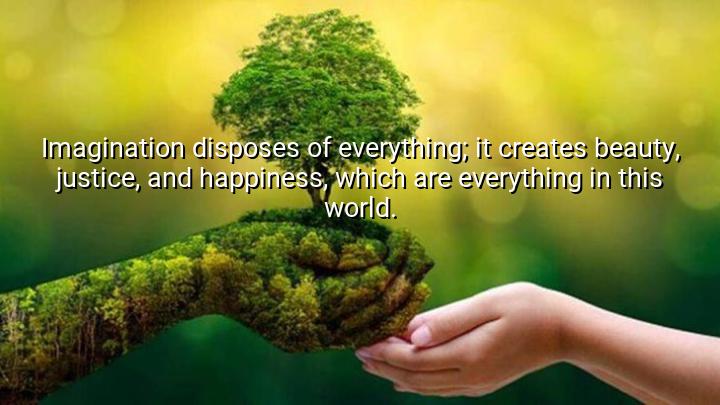




The quote by Blaise Pascal, "Imagination disposes of everything; it creates beauty, justice, and happiness, which are everything in this world," reflects the immense power of the imagination in shaping human experience and reality. Pascal, a French mathematician, philosopher, and theologian, suggests that imagination is not only a tool for creativity but a force that shapes and defines our understanding of key aspects of life. He proposes that beauty, justice, and happiness—fundamental values in human existence—are not purely objective or external realities but are instead brought into being by the imaginative capacity of the human mind.
Pascal's statement implies that imagination is a driving force behind how we perceive the world and how we construct our values and emotions. Beauty is not merely something we find in the physical world, but something we create through our perceptions and interpretations. Similarly, justice and happiness are not inherent in the world itself, but are concepts that we develop and pursue through our imaginative engagement with society and our ideals.
The quote also highlights the idea that the mind has the ability to influence our experience of the world, suggesting that how we imagine and perceive reality shapes our emotional and moral responses. This reflects a more idealistic view of human nature, where our aspirations, shaped by our imagination, can create a world of meaning and fulfillment. Pascal’s perspective speaks to the subjective nature of human experience, where personal vision and creative thought have the power to create lasting change.
Ultimately, Pascal's quote suggests that imagination is not just a passive faculty but a creative force that shapes not only art and literature but also the foundational aspects of human life, like justice, happiness, and beauty. It serves as a reminder that the world we experience is largely shaped by how we choose to perceive and imagine it.

AAdministratorAdministrator
Welcome, honored guests. Please leave a comment, we will respond soon