

I'm tired of hearing it said that democracy doesn't work. Of course it doesn't work. We are supposed to work it.
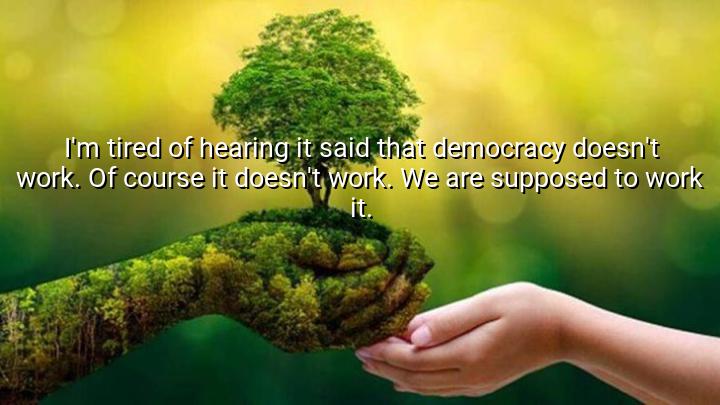




The quote by Alexander Woollcott, an American writer and critic, emphasizes the idea that democracy is not a perfect, self-sustaining system but one that requires active participation and effort from its citizens. By saying, "I'm tired of hearing it said that democracy doesn't work. Of course it doesn't work. We are supposed to work it," Woollcott challenges the notion that democracy should function automatically or without flaws. He argues that it is up to the people to make it function effectively, highlighting the responsibility of citizens to be engaged, informed, and active in the political process.
Woollcott’s statement critiques a common complaint that democracy often doesn’t deliver results or can be inefficient, especially when it’s seen as hindered by political gridlock or apathy. Instead of accepting this as an inherent flaw, he suggests that the work required for democracy is not just about voting, but about constant engagement—participating in discussions, holding leaders accountable, and ensuring that democratic ideals are upheld. This perspective reflects his belief that democracy requires effort and commitment from all individuals to ensure it functions properly.
The quote also reflects Woollcott’s idealism and faith in the potential of democracy when it is actively supported by its people. His view contrasts with a more cynical approach, which might blame the system itself for its shortcomings. Woollcott sees democracy as a tool that can succeed, but only if those who benefit from it work hard to make it succeed, instead of relying solely on elected officials or institutions.
Ultimately, Woollcott’s quote is a reminder that democracy is not a passive system, but one that requires ongoing effort and participation from the people. It underscores the collective responsibility to ensure that democratic institutions remain functional and true to their purpose, encouraging active citizenship as the cornerstone of a healthy and effective democracy.

AAdministratorAdministrator
Welcome, honored guests. Please leave a comment, we will respond soon