

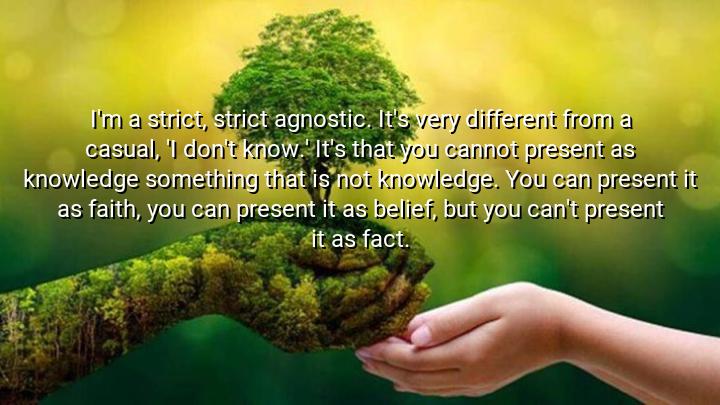
I'm a strict, strict agnostic. It's very different from a casual, 'I don't know.' It's that you cannot present as knowledge something that is not knowledge. You can present it as faith, you can present it as belief, but you can't present it as fact.
I'm a strict, strict agnostic. It's
I'm a strict, strict agnostic. It's very different from a casual, 'I don't know.' It's that you cannot present as knowledge something that is not knowledge. You can present it as faith, you can present it as belief, but you can't present it as fact.

I'm a strict, strict agnostic. It's
I'm a strict, strict agnostic. It's very different from a casual, 'I don't know.' It's that you cannot present as knowledge something that is not knowledge. You can present it as faith, you can present it as belief, but you can't present it as fact.
I'm a strict, strict agnostic. It's
I'm a strict, strict agnostic. It's very different from a casual, 'I don't know.' It's that you cannot present as knowledge something that is not knowledge. You can present it as faith, you can present it as belief, but you can't present it as fact.
I'm a strict, strict agnostic. It's
I'm a strict, strict agnostic. It's very different from a casual, 'I don't know.' It's that you cannot present as knowledge something that is not knowledge. You can present it as faith, you can present it as belief, but you can't present it as fact.
I'm a strict, strict agnostic. It's
I'm a strict, strict agnostic. It's very different from a casual, 'I don't know.' It's that you cannot present as knowledge something that is not knowledge. You can present it as faith, you can present it as belief, but you can't present it as fact.
I'm a strict, strict agnostic. It's

The quote "I'm a strict, strict agnostic. It's very different from a casual, 'I don't know.' It's that you cannot present as knowledge something that is not knowledge. You can present it as faith, you can present it as belief, but you can't present it as fact." is attributed to Margaret Atwood, a renowned Canadian author known for her sharp intellect and exploration of complex themes such as truth, belief, and knowledge. This statement emphasizes the distinction between agnosticism and mere uncertainty, stressing a principled stance on the nature of knowledge and belief.

Atwood describes being a “strict agnostic” as a commitment to intellectual honesty—acknowledging that one should not claim something as fact unless it is supported by evidence. Unlike a casual “I don’t know,” strict agnosticism insists on recognizing the limits of what can be known and warns against conflating faith or belief with empirical truth. This perspective values clarity and rigor in discussions about existence, religion, and knowledge.

The quote reflects Atwood’s broader themes of questioning assumptions and encouraging critical thinking. It challenges people to be precise in how they categorize their beliefs and to respect the boundaries between what can be proven and what must be accepted on faith or personal conviction.

In essence, Atwood’s statement serves as a thoughtful reminder about the importance of distinguishing knowledge from belief. It advocates for intellectual integrity and careful consideration in how we present and understand truth.

Margaret Atwood
Margaret Atwood

Canadian - Novelist Born: November 18, 1939

Have 0 Comment I'm a strict, strict agnostic. It's

AAdministratorAdministrator

Welcome, honored guests. Please leave a comment, we will respond soon

Reply.
Information sender
Leave the question
Click here to rate
Information sender
0.44527 sec| 2560.602 kb