

If you pay attention to the world, it's an amazing place. If you don't, it's whatever you think it is.
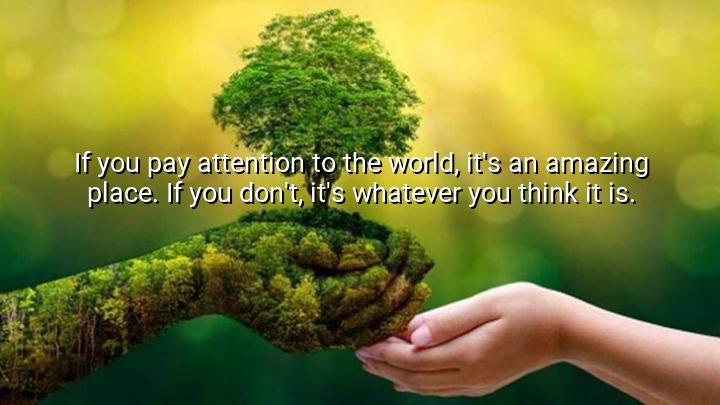




The quote "If you pay attention to the world, it's an amazing place. If you don't, it's whatever you think it is." by Reggie Watts speaks to the importance of awareness and perspective in shaping how we experience the world. Watts suggests that when we are truly present and attentive, the world reveals its wonder, complexity, and beauty. However, if we fail to engage with our surroundings, we reduce them to whatever we choose to believe or perceive, missing out on the richness that exists all around us.
Reggie Watts, a musician, comedian, and improviser, is known for his creative and unique approach to performance and thought. His quote reflects his belief in the power of mindfulness and curiosity—that the world becomes more vibrant and interesting when we actively pay attention to it. Watts emphasizes that the attitude we take toward life deeply influences our experience, shaping whether we see the world as extraordinary or mundane.
The origin of this quote likely stems from Watts’ own experiences as a performer and observer of human behavior. Through his work, Watts engages with people and environments in dynamic and creative ways, which may have led him to this realization about the role awareness plays in shaping our reality. His statement is a reminder to stay engaged with life, encouraging us to look beyond the surface and recognize the beauty and complexity in even the most ordinary moments.
Ultimately, Watts’ quote encourages us to be mindful and attentive to the world around us. By paying closer attention, we can open ourselves up to new perspectives and experiences, allowing us to fully appreciate the amazingness of life. The quote also highlights how our perceptions can limit or enhance the richness of our lives, depending on how much we are willing to engage with the world as it truly is.

CT41. Pham Cao Tri
This quote challenges me to be more intentional with my attention. In an era of constant distractions, social media, and shallow scrolling, it's easy to miss the everyday brilliance of the world. What if wonder isn’t about grand events, but about tuning in more deeply to what’s already here? Reggie Watts reminds me that our mindset shapes our experience—so how can I slow down and really notice what’s happening around me?
VTNguyen Van Tuan
I appreciate the almost philosophical depth of this quote. It draws attention to perception and subjectivity—how the world can be fascinating or dull depending on our mental engagement. But it also makes me wonder: are some people too overwhelmed to pay attention? Can trauma, anxiety, or stress dull our ability to experience amazement? It’s an empowering message, but also one that deserves nuance. Not everyone has the luxury of being fully tuned in.
NANguyen Nhat anh
This quote hit me harder than I expected. It makes me question how often I really *see* the world around me. Am I appreciating the little things—the sounds, the colors, the people—or just coasting through my assumptions? Reggie Watts seems to be calling for presence, but it also feels like a critique of indifference. Can we change our entire outlook on life just by paying closer attention? It’s a hopeful thought.
POPhuong Oanh
I find this quote both simple and profound. It suggests that beauty and meaning are available to us, but only if we choose to see them. I wonder, though, what counts as 'paying attention'? Is it mindfulness, curiosity, empathy? And in a society where information overload is the norm, how do we separate real awareness from passive consumption? There's something quietly challenging about this perspective—it puts responsibility back on us.
KTNguyen Kim Thao
This quote makes me think about how much of our reality is shaped by awareness. If we truly engage with the world—observe, listen, question—it becomes so much richer. But if we're disconnected, we're just projecting assumptions. How can we train ourselves to be more present in a world full of distractions? Is paying attention a skill, or a mindset? Reggie Watts seems to suggest it’s the key to experiencing wonder.