

If you have a government that is elected, they need to do the hard work - because if they don't, they won't be around the next time the ballot box is open.
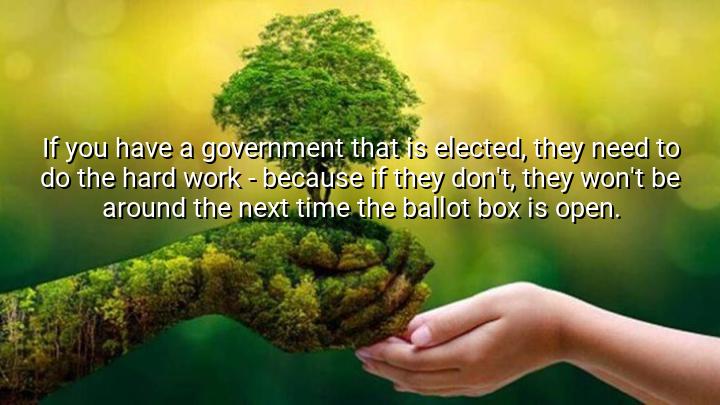




In this quote, Abdullah II of Jordan emphasizes the responsibility of an elected government to do the hard work required to serve the people effectively. He suggests that governments are accountable to their citizens, and if they fail to meet expectations or address the needs of the population, they risk losing the trust and support of the people. In this context, elections serve as a mechanism for holding leaders accountable, with the ballot box providing a direct means for citizens to express their dissatisfaction with ineffective leadership.
Abdullah’s statement underscores the importance of accountability in a democracy. It suggests that being elected is not a guarantee of continued power, and governments must earn the right to stay in office by demonstrating their ability to govern well. The quote reflects a democratic principle where leaders are not immune to the consequences of their actions, and failure to govern responsibly can lead to their removal through the electoral process.
The origin of this quote is tied to Abdullah II’s position as the King of Jordan, where he has played a key role in promoting political reform and fostering democratic values in the kingdom. While Jordan is a constitutional monarchy with a parliament, Abdullah has often spoken about the importance of good governance and the need for political accountability. This quote highlights his belief that even leaders with established authority must earn their position through active engagement and responsible decision-making.
Ultimately, Abdullah’s quote reinforces the idea that democratic governance requires leaders to remain responsive and effective in their roles. If governments do not prioritize the needs of their citizens and fail to perform their duties, they risk losing their legitimacy and facing consequences in future elections. This reflects the dynamic relationship between government and citizens in a democratic system, where power is continually earned and reaffirmed through responsible leadership.

AAdministratorAdministrator
Welcome, honored guests. Please leave a comment, we will respond soon