

If we could give every individual the right amount of nourishment and exercise, not too little and not too much, we would have found the safest way to health.
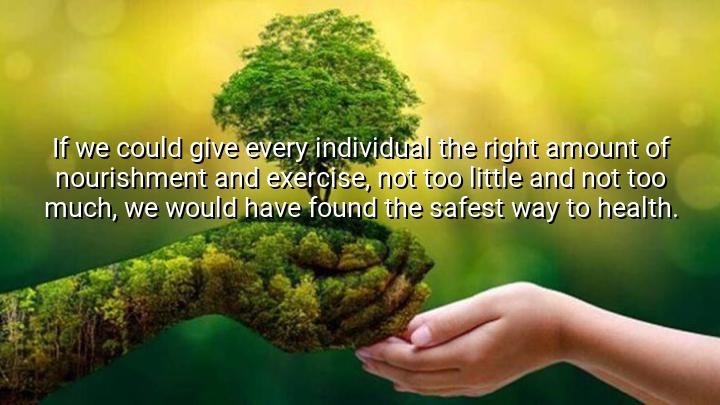




In this quote, Hippocrates, often regarded as the father of modern medicine, articulates a timeless principle about balance in health. He states, "If we could give every individual the right amount of nourishment and exercise, not too little and not too much," emphasizing that moderation is key to achieving and maintaining well-being. This idea of balance—between food intake and physical activity—is central to the holistic approach Hippocrates advocated throughout his work.
Hippocrates believed that health was not merely the absence of disease, but a state of equilibrium within the body, influenced by lifestyle, environment, and daily habits. In this quote, he implies that both under-nourishment and overindulgence, along with both inactivity and overexertion, can be detrimental. The path to good health lies in finding the "right amount" tailored to each individual's needs—a remarkably advanced concept for his time and still highly relevant today.
By concluding with, "we would have found the safest way to health," Hippocrates frames this balanced lifestyle not just as ideal, but as the most reliable and effective path to prevent illness. His focus on preventive care—encouraging people to live wisely to avoid sickness—forms the foundation of many modern health practices and reflects his broader medical philosophy centered on nature and personal responsibility.
The origin of this quote lies in Hippocratic teachings from ancient Greece, around the 5th century BCE. Though exact attributions are sometimes debated due to translations and historical transmission, this quote reflects the core values expressed in texts associated with Hippocratic medicine. His legacy lives on in the Hippocratic Oath, and his insights—like this one—continue to influence contemporary views on nutrition, exercise, and public health.

AAdministratorAdministrator
Welcome, honored guests. Please leave a comment, we will respond soon