

If we are to judge of love by its consequences, it more nearly resembles hatred than friendship.
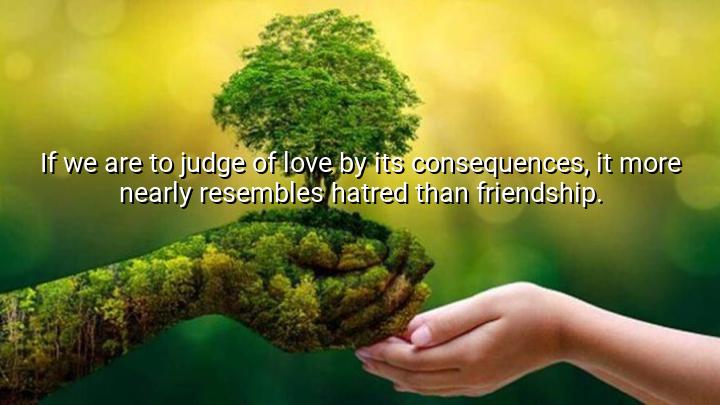




In this quote, Francois de La Rochefoucauld presents a cynical view of love, suggesting that its outcomes often mirror the destructive and divisive nature of hatred more than the nurturing qualities of friendship. He implies that, while love may seem positive in theory, it often leads to conflict, jealousy, pain, and suffering, much like the negative effects of hatred. This perspective challenges the idealized notion of love, pointing out that its consequences are not always peaceful or harmonious.
By comparing love to hatred, La Rochefoucauld highlights the intense emotions that both feelings provoke. While friendship typically fosters mutual respect and understanding, love can lead to possessiveness, exclusivity, and emotional turmoil, which are more akin to the destructive nature of hatred. This suggests that love can be a powerful force, but not necessarily a positive or constructive one, as it often creates more tension than peace.
The origin of this quote lies in La Rochefoucauld’s broader body of work, in which he often explored the complexities and contradictions of human nature. As a French philosopher and writer in the 17th century, La Rochefoucauld was known for his maxims—short, pithy statements that reflect the sometimes harsh truths about society and personal relationships. His works, which focused on human psychology and the nature of emotions, questioned the sincerity of various social and personal dynamics, including love.
Ultimately, La Rochefoucauld’s quote serves as a reflection on the contradictions of love. While it is often seen as a positive emotion, its consequences can be just as harmful and divisive as those of hatred, leading to unresolved conflict and emotional damage. This perspective encourages a deeper examination of the impact of love on human relationships, urging us to consider not just the feelings it evokes, but the outcomes it produces.

AAdministratorAdministrator
Welcome, honored guests. Please leave a comment, we will respond soon