

If there was an observer on Mars, they would probably be amazed that we have survived this long.
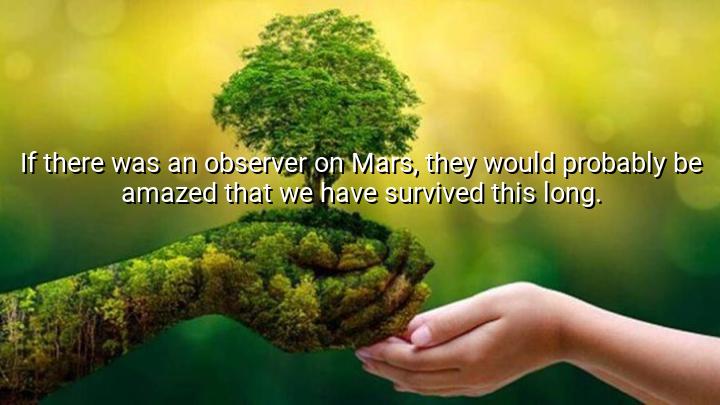




The quote by Noam Chomsky — "If there was an observer on Mars, they would probably be amazed that we have survived this long." — reflects Chomsky’s perspective on the fragile and often self-destructive nature of human society. He suggests that, from an external viewpoint, such as that of a hypothetical observer on another planet, it might seem incredible that humanity has endured the challenges it has faced, from wars to environmental degradation, without completely collapsing. This statement highlights the unpredictability of human survival, given the numerous risks and conflicts we've encountered over time.
Chomsky's quote also draws attention to the resilience of humanity, despite its shortcomings. While the world faces constant threats — political, environmental, and social — we have managed to continue, often in spite of ourselves. The amazement stems from the fact that, despite our capacity for destruction and self-sabotage, we have not only survived but adapted to many of the crises we've faced.
The origin of this quote lies in Chomsky's well-known commentary on global issues, including politics, environmental concerns, and the human tendency toward conflict. As a political theorist and linguist, Chomsky has frequently pointed out the vulnerabilities and risks inherent in human societies. His remark is a critique of human behavior and governance, suggesting that the continued survival of humanity is more surprising than guaranteed.
Ultimately, Chomsky’s quote serves as a reflection on humanity’s ability to survive despite its flaws and challenges. It’s a reminder that, in the grand scheme of things, our existence is tenuous and, without deliberate effort to address global issues like climate change, political instability, and social injustice, we may not continue to thrive. The amazement comes not from our success, but from the fact that we have lasted this long in a world filled with self-inflicted dangers.

UGUser Google
I wonder how this quote might challenge our assumptions about progress. We often think of ourselves as the pinnacle of intelligence and civilization, but from an outsider’s point of view, maybe we just look reckless and self-destructive. It’s kind of humbling. How do we reconcile our technological advancement with our inability to solve existential crises like climate change or global conflict?
BLThi Binh Le
Honestly, this made me laugh and then made me really uncomfortable. It’s such a sharp observation. Would a rational being from another planet even comprehend why we keep choosing short-term gains over long-term survival? It begs the question: are we truly intelligent as a species, or just skilled at delaying consequences? I’d love to know what specific human behaviors Chomsky had in mind here.
NNNguyen Ngoc Nhu
This quote instantly makes me think of the Anthropocene and the current state of our planet. The fact that we’ve survived despite nuclear threats, ecological disasters, and political instability is both baffling and fascinating. Do you think human adaptability is our saving grace, or are we just incredibly lucky? And if it’s luck, how much longer can we depend on it without meaningful change?
TTThao Tran
I find this perspective both darkly humorous and deeply sobering. It’s almost like a cosmic critique of human behavior. From war to climate change to inequality, it’s amazing we haven’t self-destructed. But do you think this quote carries a warning? Maybe Chomsky is trying to wake us up—to get us to act more responsibly before the ‘amazed observer’ on Mars has to watch us disappear.
TBTam Be
This quote really hits hard. It makes me think about how much destruction, conflict, and environmental harm we’ve inflicted upon ourselves and the planet—yet somehow, we’re still standing. Is Chomsky suggesting that survival itself is irrational under current global conditions? If so, what does that say about our future? Is humanity’s continued existence a sign of resilience or just a lucky accident waiting to end?