

If the skies fall, one may hope to catch larks.
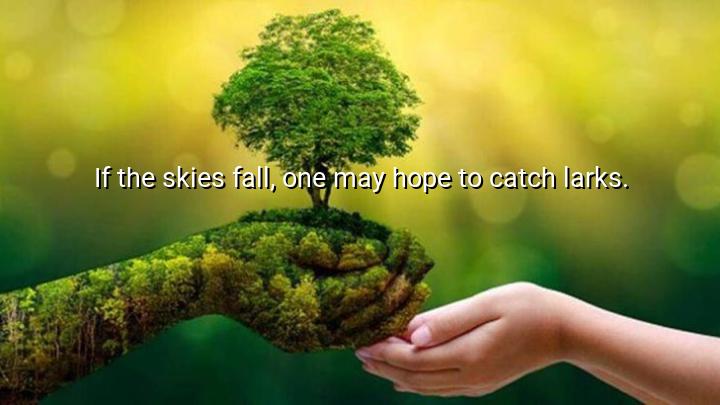




The quote "If the skies fall, one may hope to catch larks" by François Rabelais, a French writer and philosopher, presents a whimsical and somewhat ironic view on the impossibility of achieving something improbable. Rabelais is suggesting that in a scenario where disaster or the most impossible of events occurs (like the skies falling), one might still hold on to an unrealistic hope of achieving something highly unlikely, such as catching larks—a metaphor for something that is nearly impossible. The phrase embodies the idea of unrealistic expectations in the face of overwhelming or absurd circumstances.
Rabelais' words imply that while it's human nature to hope, sometimes those hopes are so far-fetched that they border on the absurd. In this case, the idea of the skies falling is an impossible event, yet the hope to "catch larks" suggests an even more impossible task. The quote can be seen as a commentary on optimism or wishful thinking in the face of difficult or even catastrophic situations, illustrating the absurdity of pursuing unattainable goals.
The origin of this quote lies in Rabelais' larger body of work, particularly his satirical and humorous writings, which often critiqued societal norms and human folly. In his famous work Gargantua and Pantagruel, Rabelais used absurd situations, exaggerated characters, and dark humor to address the complexities of human nature, philosophy, and society. This quote, with its playful tone, is a perfect example of his style, blending the fantastical with deeper reflections on human behavior and expectations.
Ultimately, this quote serves as a reminder about the nature of hope and the tendency to pursue unrealistic dreams, especially in the face of insurmountable challenges. It suggests that while it's natural to have hope, it's also important to recognize when expectations are too far removed from reality. Through Rabelais’ wit, we are reminded that sometimes chasing improbable goals can be just as absurd as attempting to catch something as elusive as a lark during a falling sky.

AAdministratorAdministrator
Welcome, honored guests. Please leave a comment, we will respond soon