

If the misery of the poor be caused not by the laws of nature, but by our institutions, great is our sin.
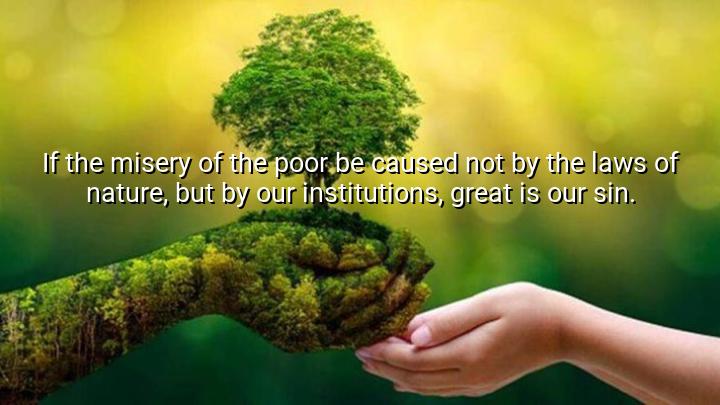




In this quote, Charles Darwin reflects on the role that human institutions play in perpetuating the misery of the poor. He suggests that if the suffering of the poor is not a natural consequence of nature or unavoidable forces, but is instead caused by societal systems and structures, then those responsible for these systems are committing a great sin. Darwin’s use of the word “sin” highlights the moral responsibility that society holds for allowing such inequality and suffering to persist.
Darwin is pointing out that inequality, poverty, and social injustice are not necessarily inevitable or natural conditions, but are often the result of man-made systems such as political, economic, and social institutions. His words suggest that society, if it allows such suffering to continue, is complicit in the harm inflicted on the vulnerable. The quote calls attention to the responsibility of those in power to create fairer, more equitable systems that do not contribute to human suffering.
The origin of this quote aligns with Darwin’s broader views on social responsibility and human progress. Although best known for his work on evolution and natural selection, Darwin also had a strong interest in social issues and the impacts of human structures on society. In this quote, he emphasizes that the well-being of humanity should not be hindered by oppressive institutions, urging for reform and a deeper sense of moral duty.
Ultimately, Darwin’s quote underscores the idea that social inequality is not just an issue of economic concern, but a moral one. It challenges us to look critically at the systems we live in and to ask whether they contribute to human flourishing or perpetuate misery. The call for reform, rooted in a moral framework, highlights the importance of addressing structural inequalities to improve the lives of the disadvantaged.

AAdministratorAdministrator
Welcome, honored guests. Please leave a comment, we will respond soon