

If the machine of government is of such a nature that it requires you to be the agent of injustice to another, then, I say, break the law.
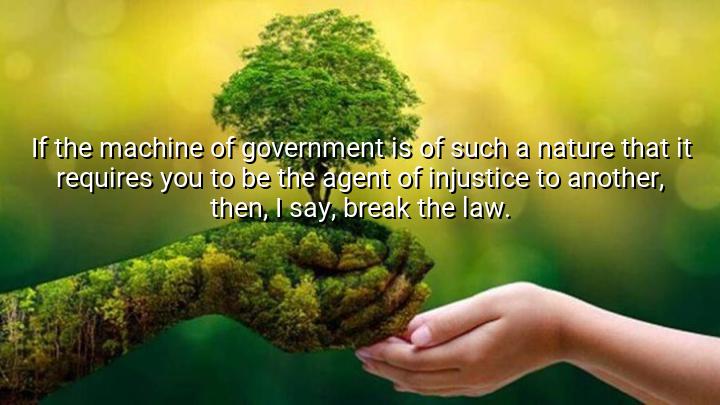




The quote, "If the machine of government is of such a nature that it requires you to be the agent of injustice to another, then, I say, break the law," by Henry David Thoreau, speaks to the moral responsibility of individuals to resist unjust laws and governmental systems that demand immoral actions. Thoreau, a philosopher, essayist, and transcendentalist, is best known for his writings on civil disobedience and individual conscience. In this quote, Thoreau argues that if a government or law forces you to act in ways that violate your moral beliefs or perpetrate injustice against others, it is not only acceptable but also necessary to resist by breaking the law.
Thoreau’s statement emphasizes the primacy of personal conscience over blind obedience to the state. He believed that people should not unquestioningly follow laws that they believe are wrong, particularly those that harm others. For Thoreau, the act of civil disobedience—breaking the law to stand against injustice—was a moral duty, one that contributed to the betterment of society by exposing and challenging unethical systems.
The origin of this quote lies in Thoreau's famous essay, Civil Disobedience, written in 1849. The essay was a response to his own imprisonment for refusing to pay a poll tax, a protest against the Mexican-American War and the institution of slavery in the United States. Thoreau argued that individuals should not allow themselves to become complicit in immoral actions simply because they are sanctioned by the law or enforced by the government. His call for civil disobedience became a key influence on later movements for social justice and nonviolent resistance, including those led by figures like Mahatma Gandhi and Martin Luther King Jr..
This quote remains significant today, as it challenges individuals to reflect on the ethical implications of their actions within the framework of law and government. It encourages a questioning of authority, especially when laws or government actions are seen as oppressive or unjust. Thoreau's message advocates for personal responsibility in the face of institutional wrongdoing and encourages resistance when the machinery of government perpetuates harm.

AAdministratorAdministrator
Welcome, honored guests. Please leave a comment, we will respond soon