

If I could teach people to be grateful, we could have an amazing world where negativity could not grow and foster, and children would have a smile on their face.
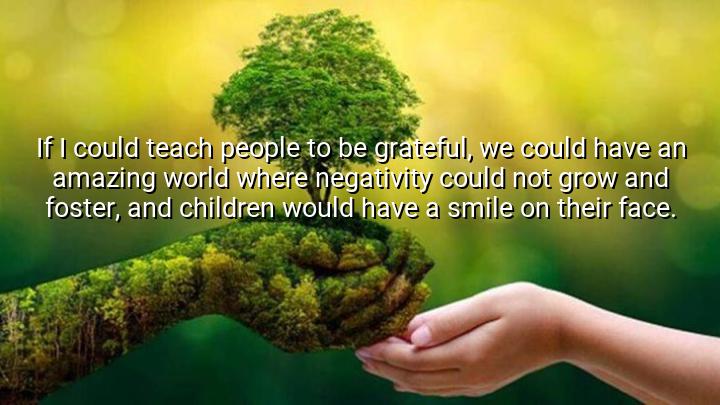




The quote by Catriona Gray — "If I could teach people to be grateful, we could have an amazing world where negativity could not grow and foster, and children would have a smile on their face." — reflects her belief in the transformative power of gratitude. Gray emphasizes that if people embraced gratitude, it would create a more positive world, free from the negative influences that often cloud human interactions. The word "amazing" highlights the profound, life-changing impact that gratitude can have on individuals and society as a whole, fostering a more optimistic and supportive environment.
Gray’s statement also suggests that negativity thrives in environments where people fail to appreciate what they have. She believes that by cultivating a culture of gratitude, people would be more focused on the positive aspects of life rather than dwelling on what is lacking. The imagery of children smiling reflects the purity and joy that can come from a simple, appreciative outlook on life, underscoring how gratitude can bring out the best in individuals, especially in younger generations.
The origin of this quote comes from Gray’s experiences as a beauty queen and humanitarian. As the winner of Miss Universe 2018, Gray used her platform to advocate for social issues and inspire positive change. Her advocacy for gratitude likely stems from her personal values and experiences, as well as her commitment to promoting kindness and joy in the world. Through her work, she encourages others to adopt gratitude as a way to build stronger, more compassionate communities.
Ultimately, Gray’s words emphasize the power of gratitude to counteract negativity and create a world filled with more positivity and joy. Her vision of a world where gratitude leads to smiles on children’s faces serves as a reminder of how small shifts in mindset can have a wide-reaching impact on our relationships and the global community. It calls for a more mindful, appreciative approach to life, which in turn can foster better connections and a brighter future.

PTTran phuong thuy-2E
This quote hits me deeply because I’ve seen firsthand how practicing gratitude can shift an entire outlook on life. But I also think we need to be careful not to oversimplify complex emotional states. Is it fair to suggest that negativity wouldn’t exist if everyone was just more grateful? Maybe some negativity is rooted in trauma or injustice. I'd be interested to hear how Catriona reconciles that tension.
HHtran huu hieu
There’s something really touching about linking gratitude to children’s happiness. I find myself wondering, what role do parents and schools play in nurturing this mindset from a young age? It’s true that emotional habits can be taught early, but in a world full of social media pressures and constant comparison, how do we keep gratitude at the center of young people’s lives?
THNguyen Thi Hang
This quote makes me think about how emotions are contagious. If children were surrounded by gratitude instead of criticism or negativity, how different would their development be? I do wonder though—how can we create environments that reinforce gratitude without coming off as dismissive of genuine pain or injustice? Sometimes ‘being grateful’ is used to silence people. Where’s the balance between appreciation and acknowledging problems?
MDMinh Dang
I love the idealism in this quote. The idea that gratitude could transform the world is both hopeful and inspiring. But how exactly would one go about teaching gratitude, especially to adults who’ve grown up in cultures that emphasize competition or material success? Is it something that can be taught in schools or modeled through community behavior? I'd love to hear concrete strategies Catriona might suggest to make this vision real.
NNganh
Gratitude really is a powerful mindset, and I appreciate how Catriona Gray connects it to larger social change. But I’m curious—can teaching gratitude alone really counteract deeper issues like poverty, inequality, and systemic negativity? It sounds beautiful, but I wonder how practical it is in environments where people are struggling just to survive. Can gratitude coexist with hardship, or does it require a baseline level of stability first?