

If a major source of the nation's news is personalizing user experiences, people with different points of view will end up in echo chambers of their own design. Facebook didn't create that problem, but it shouldn't aggravate it.
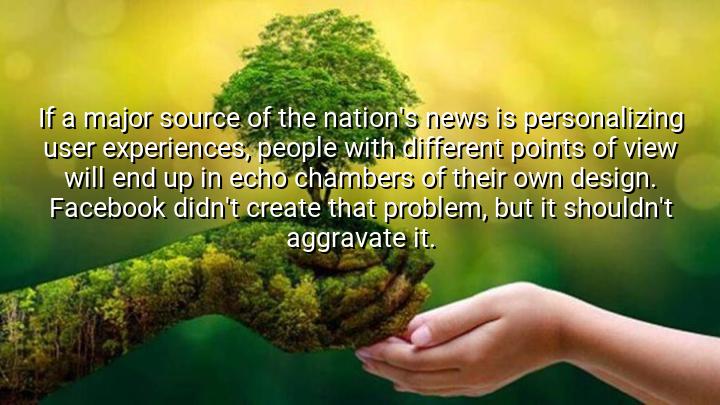




The quote by Cass Sunstein addresses the dangers of personalized news and its impact on democracy. When he says, “If a major source of the nation’s news is personalizing user experiences, people with different points of view will end up in echo chambers of their own design,” he is warning that algorithm-driven content curation can trap individuals in echo chambers, where they only see opinions that reinforce their existing beliefs. This reduces exposure to diverse perspectives and deepens political and social polarization.
Sunstein adds, “Facebook didn’t create that problem, but it shouldn’t aggravate it,” acknowledging that social media platforms are not solely responsible for echo chambers—since people naturally gravitate toward like-minded views—but that these platforms intensify the issue through algorithms that prioritize engagement over balance. His point is that while personalization makes platforms more appealing, it also increases the risk of fragmentation in public discourse if not managed responsibly.
The origin of this quote lies in Sunstein’s work as a legal scholar and expert on information law, behavioral economics, and constitutional theory. He has written extensively on the effects of digital media on society, particularly in his book #Republic: Divided Democracy in the Age of Social Media. His concerns stem from years of studying how information environments shape public opinion, and he has consistently advocated for structures that encourage exposure to diverse viewpoints.
Ultimately, Sunstein’s words highlight the tension between technology and civic responsibility. While personalization can make news consumption more convenient and enjoyable, it also risks undermining the public sphere by preventing citizens from engaging with differing perspectives. His quote serves as both a critique of platforms like Facebook and a call to ensure that digital innovation strengthens, rather than weakens, the foundations of democracy.

AAdministratorAdministrator
Welcome, honored guests. Please leave a comment, we will respond soon