

I would say that to put architecture in the chain of history, to be able to interpret and understand why we are where we are, is quite crucial.
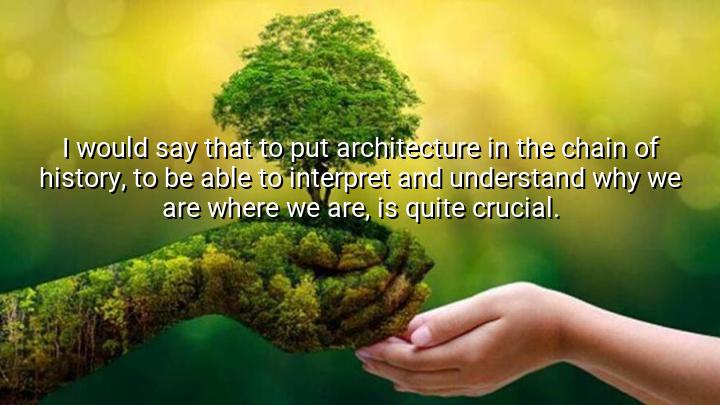




The quote by Rafael Moneo, “I would say that to put architecture in the chain of history, to be able to interpret and understand why we are where we are, is quite crucial,” highlights the architect’s deep belief in the importance of understanding architecture as a product of historical context. Moneo emphasizes that architecture does not exist in a vacuum; instead, it is shaped by and contributes to the cultural, political, social, and artistic currents of its time. By placing architecture within the “chain of history,” he underscores the value of continuity, tradition, and reflection in the design process.
For Moneo, understanding why we are where we are requires looking back at how architectural ideas and forms have evolved, how past solutions inform present challenges, and how historical memory can be embedded in contemporary structures. This perspective stands in contrast to purely avant-garde or ahistorical approaches that aim only for innovation without grounding. Moneo advocates for a more thoughtful, interpretive practice—one that respects the narrative of architecture as a form of cultural storytelling.
As a Pritzker Prize-winning architect, Moneo is known for designs that balance modernity with tradition, often blending new structures seamlessly into historically rich contexts. Projects like the Cathedral of Our Lady of the Angels in Los Angeles and the Murcia Town Hall in Spain reflect this sensitivity to site, history, and civic identity. His work demonstrates that meaningful architecture arises from a conversation with the past, not just a vision for the future.
The origin of this quote lies in Moneo’s lectures and interviews, where he often explores architecture’s role as a cultural and intellectual discipline. His emphasis on interpretation and historical awareness calls upon architects to be not only designers but also historians, thinkers, and caretakers of memory. In doing so, Moneo positions architecture as a discipline deeply connected to understanding human progress through built form.

AAdministratorAdministrator
Welcome, honored guests. Please leave a comment, we will respond soon