

I was anorexic in the '60s and '70s, although it wasn't called anorexia then. I thought people would be nicer to me if I looked very small and delicate, so food wasn't high on my agenda. But it is now.
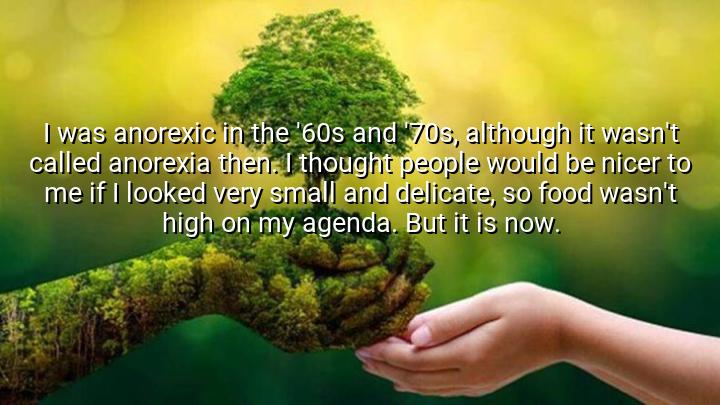




The quote “I was anorexic in the '60s and '70s, although it wasn't called anorexia then. I thought people would be nicer to me if I looked very small and delicate, so food wasn't high on my agenda. But it is now.” by Marianne Faithfull reveals a deeply personal reflection on her struggles with body image, self-worth, and disordered eating during a time when such issues were poorly understood and rarely discussed. Faithfull, an English singer, actress, and icon of the 1960s counterculture, candidly shares how societal and personal pressures led her to neglect her relationship with food in pursuit of acceptance and approval.
Her acknowledgment that it “wasn't called anorexia then” points to the lack of awareness and diagnostic understanding of eating disorders in past decades. During the '60s and '70s, ideals of femininity and beauty often glorified thinness, particularly in celebrity and fashion circles. Faithfull’s desire to appear “small and delicate” reflects a belief—common at the time—that physical frailty equated to desirability, especially for women. In trying to conform to these standards, she sacrificed her health and well-being.
However, the final statement—“But it is now”—marks a powerful turning point. It signifies her healing, self-awareness, and a newfound appreciation for food and the role it plays in nurturing both body and spirit. It also serves as a subtle critique of the culture that once encouraged her to deprive herself. This change in her mindset highlights the possibility of recovery and personal growth, even after years of struggling with distorted perceptions of self-image.
Ultimately, Faithfull’s quote is a moving account of survival and self-discovery. It speaks to broader themes of how societal expectations can impact mental and physical health, particularly among women in the public eye. Her openness helps break the silence around eating disorders, offering encouragement to others who may be navigating similar challenges, and reminding us that it’s never too late to rebuild a positive relationship with food and self.

AAdministratorAdministrator
Welcome, honored guests. Please leave a comment, we will respond soon