

I think what's really amazing is that given the scale of the web and getting the compute power we have today, we're starting to see things that appear intelligent but actually aren't semantically intelligent.
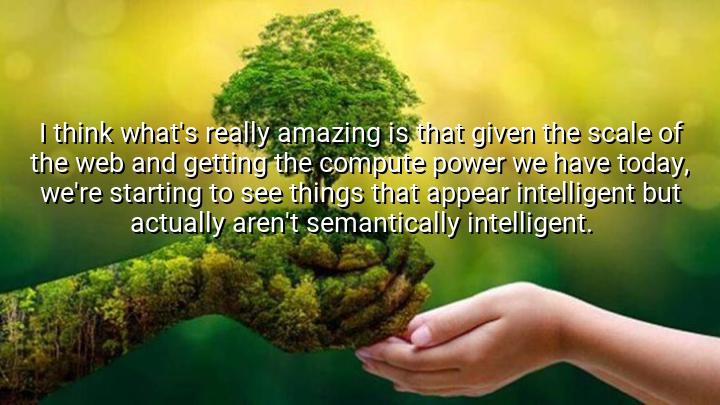




The quote by Marissa Mayer, former executive at Google and Yahoo, highlights a crucial insight about the state of modern artificial intelligence and the internet. She observes that with the vast scale of the web and the immense compute power available today, we are now encountering systems and tools that seem intelligent, but upon closer inspection, lack true semantic understanding. In other words, they mimic human-like intelligence but do not actually understand meaning the way humans do.
The term "semantically intelligent" refers to the ability to genuinely grasp and process the meaning behind words and concepts, not just recognize patterns. Many current AI systems, including language models and search engines, operate by analyzing massive datasets to generate statistically likely responses, but they do not possess consciousness, contextual awareness, or true comprehension. They simulate intelligence, but do not internalize or interpret the world with human-level understanding.
The origin of this quote lies in Mayer’s work at the forefront of web technologies, where she observed firsthand how developments in machine learning and data processing transformed user experiences. However, her statement is also a subtle caution. It reminds us that despite the impressive advances in AI performance, we should not conflate computational mimicry with genuine cognition. What looks intelligent may not truly be intelligent in the human sense.
In summary, Mayer’s quote encourages a more nuanced view of AI capabilities. While today’s systems can perform amazing feats thanks to vast data and computational resources, they still fall short of true semantic understanding. Her insight is a reminder to temper our expectations and continue questioning the depth of intelligence in these technologies.

LDLe Duc
This really challenges the hype we see around AI. If something only appears intelligent but lacks actual semantic understanding, should it be trusted to make decisions or generate content? I think there’s a huge responsibility on tech leaders and developers to help the public understand what these systems can and can’t do. What do you think: is it ethical to build tools that can pass as intelligent without truly understanding anything?
NNhien
Mayer’s quote brings to mind the Turing Test and how we often use surface-level performance as a benchmark for intelligence. But if something ‘seems’ intelligent without truly understanding what it's doing, is that good enough? Or are we lowering the bar for what intelligence means? I’d love to hear what others think the threshold for 'real' intelligence should be in machines—and whether semantic understanding is a necessary part of it.
LCLong Chau
I find this perspective by Marissa Mayer quite sobering. With so much excitement around AI advancements, it's easy to forget that a lot of what we call ‘intelligence’ is just well-crafted pattern recognition. Is there a risk that society will treat these tools as more capable than they really are, especially in critical areas like medicine, law, or education? Should developers be doing more to clarify that these systems aren’t truly intelligent in the human sense?
TTHuynh Thi Thuy Trang
Mayer brings up an important distinction that often gets overlooked in tech conversations. We’re building systems that can mimic language and thought, but are we mistaking imitation for true intelligence? I wonder, does this illusion of intelligence actually make us more vulnerable to misinformation or over-reliance on machines? Should there be more transparency in AI systems about their actual capabilities versus their perceived ‘smartness’?
KKh3m
This quote really hits on a major concern I’ve had with AI lately. So many tools seem ‘smart,’ but when you dig deeper, they often fall apart on more complex or nuanced topics. Do you think people are too quick to assume these systems are actually intelligent, or is it just human nature to anthropomorphize technology? I’d be curious to hear where others draw the line between functional performance and real comprehension.