

I thank you God for this most amazing day, for the leaping greenly spirits of trees, and for the blue dream of sky and for everything which is natural, which is infinite, which is yes.
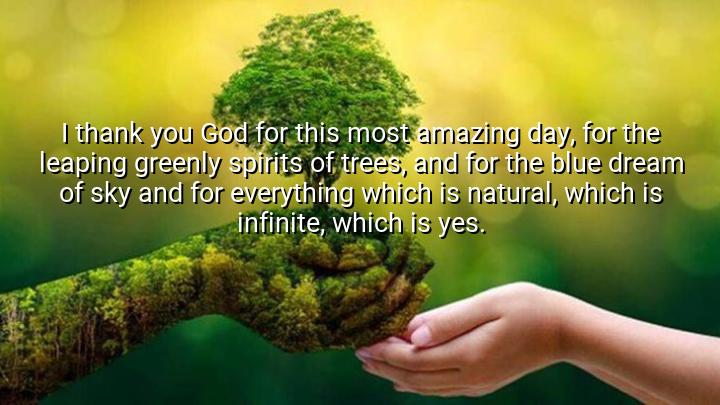




The quote by e. e. cummings — "I thank you God for this most amazing day, for the leaping greenly spirits of trees, and for the blue dream of sky and for everything which is natural, which is infinite, which is yes." — expresses a profound sense of gratitude for the beauty of nature and the wonders of the world. Cummings' use of "amazing" highlights his awe and appreciation for the natural world, framing it as a gift from God. The imagery of the trees as "leaping greenly spirits" and the sky as a "blue dream" suggests that Cummings perceives nature as alive and dynamic, filled with energy and wonder.
The quote also emphasizes the infinite and ever-present qualities of nature. Cummings contrasts the fleeting, temporary aspects of human life with the eternal and unchanging presence of the natural world, which continues to exist and inspire awe. By using the word "yes", he implies an embrace of life, nature, and existence itself, suggesting acceptance, joy, and openness to the world around him. This reflects Cummings' typical style of celebrating life in its purest and most organic form.
The origin of the quote is rooted in Cummings' characteristic style of celebrating the beauty of the world, often using unconventional syntax and grammar to express his emotions and thoughts. Known for his poetic exploration of nature, love, and individuality, Cummings frequently found inspiration in the natural world, seeing it as a source of profound spiritual connection. This quote, like many of his works, reflects his deep sense of wonder and reverence for life itself.
Ultimately, Cummings’ words convey an attitude of deep gratitude and reverence for the natural world. His description of nature as something that is infinite and inherently good reflects his belief in the interconnectedness of life, urging us to recognize the beauty in the world and appreciate the simple, yet profound, things around us. The quote invites the reader to pause and acknowledge the joy and life that surrounds them every day.

NCNga Chi
I’m struck by how romantic and lyrical this is without feeling overly sentimental. It makes me think—can poetry help us reframe the way we perceive daily life? Even mundane things become sacred through this kind of lens. Should we be incorporating more poetic reflection into our routines to keep ourselves grounded and more emotionally connected to the world around us?
HPChung Hieu Phan
I find this quote deeply moving. But is this level of gratitude something you’re born with, or something you learn over time? Some people seem to notice and cherish beauty everywhere, while others barely look up from their phones. What changes that perspective? Can we teach ourselves to see the world through this kind of lens, or is it an innate sensitivity?
NTNguyen Tang
This kind of expression makes me feel both inspired and a little melancholic. Do we still value the natural world like this today, or have we lost touch with that emotional connection to trees, sky, and simple moments? It feels like a gentle reminder that beauty is always there—are we just too busy or jaded to see it?
TTVi thi thuong
Reading this makes me think about spirituality in a broader sense. Is e. e. cummings talking to a specific God, or using ‘God’ as a metaphor for universal gratitude? The connection he draws between divinity and nature feels so intimate and sincere. Can modern spirituality learn from this kind of poetic reverence for the natural world?
PTPho Ta
The imagery here is just stunning. But what does he mean by 'which is yes'? That word feels so abstract and yet so powerful at the end. Is it about embracing life affirmatively? About saying 'yes' to existence itself? I love how cummings uses language in such an open, emotional way—it leaves room for interpretation, but also feels deeply personal.