

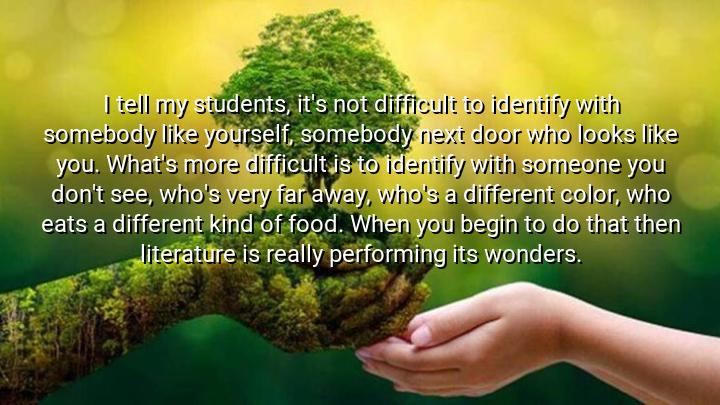
I tell my students, it's not difficult to identify with somebody like yourself, somebody next door who looks like you. What's more difficult is to identify with someone you don't see, who's very far away, who's a different color, who eats a different kind of food. When you begin to do that then literature is really performing its wonders.
I tell my students, it's not
I tell my students, it's not difficult to identify with somebody like yourself, somebody next door who looks like you. What's more difficult is to identify with someone you don't see, who's very far away, who's a different color, who eats a different kind of food. When you begin to do that then literature is really performing its wonders.

I tell my students, it's not
I tell my students, it's not difficult to identify with somebody like yourself, somebody next door who looks like you. What's more difficult is to identify with someone you don't see, who's very far away, who's a different color, who eats a different kind of food. When you begin to do that then literature is really performing its wonders.
I tell my students, it's not
I tell my students, it's not difficult to identify with somebody like yourself, somebody next door who looks like you. What's more difficult is to identify with someone you don't see, who's very far away, who's a different color, who eats a different kind of food. When you begin to do that then literature is really performing its wonders.
I tell my students, it's not
I tell my students, it's not difficult to identify with somebody like yourself, somebody next door who looks like you. What's more difficult is to identify with someone you don't see, who's very far away, who's a different color, who eats a different kind of food. When you begin to do that then literature is really performing its wonders.
I tell my students, it's not
I tell my students, it's not difficult to identify with somebody like yourself, somebody next door who looks like you. What's more difficult is to identify with someone you don't see, who's very far away, who's a different color, who eats a different kind of food. When you begin to do that then literature is really performing its wonders.
I tell my students, it's not

This quote by Chinua Achebe emphasizes the transformative power of literature in cultivating empathy and understanding across cultural and personal boundaries. Achebe points out that it’s easy to identify with people who are familiar—those who look like us, live near us, and share our customs. However, true growth happens when we learn to identify with those who are different—people who are far away, of a different race, who eat different food, and live different lives.

By saying, “When you begin to do that then literature is really performing its wonders,” Achebe highlights the role of storytelling in bridging cultural divides. Literature becomes a powerful tool not only for representation but also for human connection. It invites readers to see the world through the eyes of others, challenging prejudice, ignorance, and isolation. In this way, books become more than entertainment—they become a means of fostering compassion and global awareness.

The origin of this quote is rooted in Achebe’s lifelong mission to reclaim African narratives and to challenge the colonial lens through which African societies had long been portrayed in Western literature. As the author of Things Fall Apart and other seminal works, Achebe devoted his career to creating authentic representations of African life and to emphasizing the importance of voice and visibility for marginalized communities.

Ultimately, Achebe’s message serves as a reminder that literature reaches its highest purpose when it pushes us beyond our comfort zones—when it teaches us to care for and connect with people whose experiences are vastly different from our own. In doing so, it nurtures the kind of empathy that is essential to a more just and inclusive world.

Chinua Achebe
Chinua Achebe

Nigerian - Writer November 16, 1930 - March 21, 2013

Have 0 Comment I tell my students, it's not

AAdministratorAdministrator

Welcome, honored guests. Please leave a comment, we will respond soon

Reply.
Information sender
Leave the question
Click here to rate
Information sender
0.26624 sec| 2560.25 kb