

I still believe many poets begin in fear and hope: fear that the poetic past will turn out to be a monologue rather than a conversation. And hope that their voice can be heard as that past turns into a future.
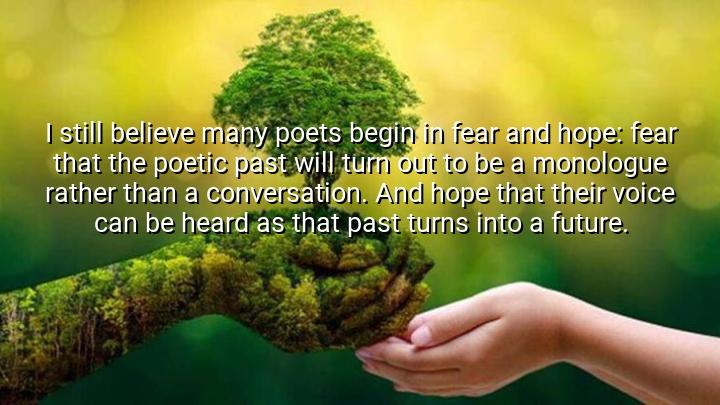




Eavan Boland’s quote delves into the emotions and challenges that poets often face as they navigate the literary tradition. By stating, "many poets begin in fear and hope," she highlights two powerful motivations that drive writers: fear and hope. The fear comes from the concern that the poetic past, which refers to the rich history of poetry that has come before, may become a monologue—a one-sided conversation that leaves little room for new voices or fresh perspectives. Poets fear that their work might be overshadowed by the weight of tradition, or that they won't be able to contribute to the ongoing dialogue of poetry.
On the other hand, Boland introduces the hope that poets harbor: "hope that their voice can be heard as that past turns into a future." This reflects the belief that new voices can emerge from the past and transform it into something relevant and forward-looking. Poets hope their work will be recognized and valued in the context of both historical poetry and the future of the craft. Their desire is to ensure that their contributions are not just a continuation of past traditions, but a new and important step in the evolution of poetry.
The metaphor of poetry as a conversation rather than a monologue speaks to the idea that art is an interactive and evolving practice. A conversation suggests an exchange of ideas, with new voices continually entering the dialogue, while a monologue can imply a static or one-way process, where only one voice dominates. By framing poetry this way, Boland emphasizes that poets are not simply repeating what has been said, but are actively engaging with the past to create something meaningful for the future.
In essence, Boland’s quote captures the dual struggle of poets: the fear of being lost in the long shadow of poetic tradition and the hope of finding their own voice within it. This dynamic reflects the tension between honoring the past while contributing something new and relevant to the future of poetry.

AAdministratorAdministrator
Welcome, honored guests. Please leave a comment, we will respond soon