

I said to my soul, be still, and wait without hope, For hope would be hope for the wrong thing.
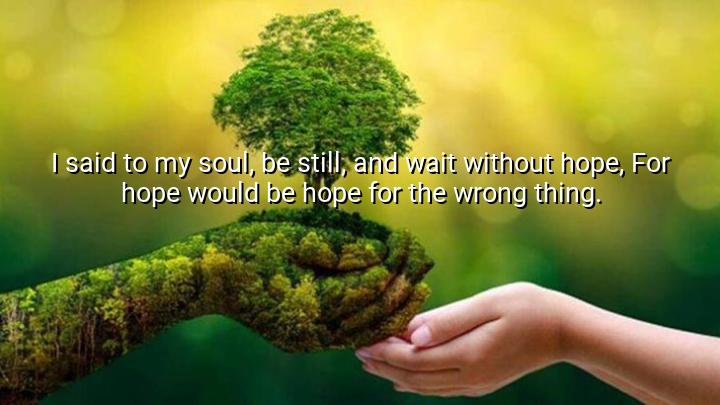




T.S. Eliot’s quote, “I said to my soul, be still, and wait without hope, For hope would be hope for the wrong thing,” reflects a deeply contemplative and philosophical perspective on the nature of hope and desire. In this line, Eliot suggests that hope, when directed toward unattainable or misguided goals, can be a source of frustration and misdirection. The idea of waiting "without hope" implies a state of acceptance and detachment, where one is not yearning for something that may never come or is not aligned with their deeper truth.
By instructing his soul to "be still," Eliot emphasizes the importance of inner calm and reflection. In moments of uncertainty or emotional turmoil, he advocates for stillness and a release from the constant pursuit of hope for something that might not serve one's true needs. The quote suggests that hope can sometimes be an illusion, distracting us from a more profound sense of peace or understanding. In this context, hope is seen as something that might lead one astray, especially if it is based on false or unrealistic expectations.
Eliot’s work is often centered around themes of alienation, suffering, and the complexities of the human condition. This quote, taken from his poem East Coker, reflects his exploration of existential questions and the search for meaning in a world that seems to offer little certainty. By advising to wait "without hope," Eliot challenges the common notion of hope as a saving grace, suggesting instead that true peace comes from accepting the present without the expectation of future fulfillment.
Ultimately, Eliot’s quote invites reflection on the nature of hope and the necessity of discerning when it serves us and when it might hinder our emotional and spiritual growth. His words encourage a mindful approach to life, urging one to pause, reflect, and embrace stillness rather than chasing after fleeting or illusory desires.

AAdministratorAdministrator
Welcome, honored guests. Please leave a comment, we will respond soon