

I remember being in India one time where I saw people who were struggling to find food at the bottom of a trash can, and then I walked into my hotel and saw people arguing over how the quality of food at the buffet wasn't good enough.
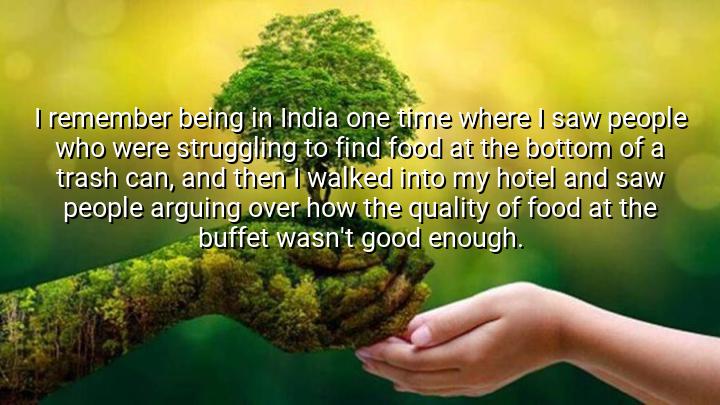




The quote “I remember being in India one time where I saw people who were struggling to find food at the bottom of a trash can, and then I walked into my hotel and saw people arguing over how the quality of food at the buffet wasn't good enough.” by Jay Shetty highlights the stark contrast between poverty and privilege, and the often overlooked inequity that exists side by side in our world. Shetty, a former monk turned author, podcaster, and motivational speaker, frequently uses such observations to reflect on gratitude, compassion, and the importance of perspective.
In this quote, Shetty contrasts the image of people scavenging for survival with those complaining about luxury, using this juxtaposition to provoke a sense of awareness and empathy. The scene he recalls is not just a memory—it’s a powerful reminder of how wealth disparity plays out in everyday life, often unnoticed or unacknowledged by those who live in comfort. His experience walking from a place of extreme need to one of excess underscores how desensitized we can become to suffering when we’re surrounded by abundance.
Shetty’s broader message is about developing consciousness and humility in the way we experience the world. He often emphasizes that true contentment and happiness stem not from accumulating more, but from recognizing what we already have and using that awareness to build compassion for others. His quote urges people to step outside their bubbles of convenience and consider the lives of those who struggle to meet basic needs.
Ultimately, this moment in India serves as a metaphor for the global imbalance between wealth and poverty, and a call to reflect on our attitudes toward food, privilege, and entitlement. Through this vivid contrast, Jay Shetty encourages us to cultivate greater gratitude, to reduce wastefulness, and to become more mindful citizens of a world where access to necessities is still a daily fight for many.

AAdministratorAdministrator
Welcome, honored guests. Please leave a comment, we will respond soon