

I recognize in thieves, traitors and murderers, in the ruthless and the cunning, a deep beauty - a sunken beauty.
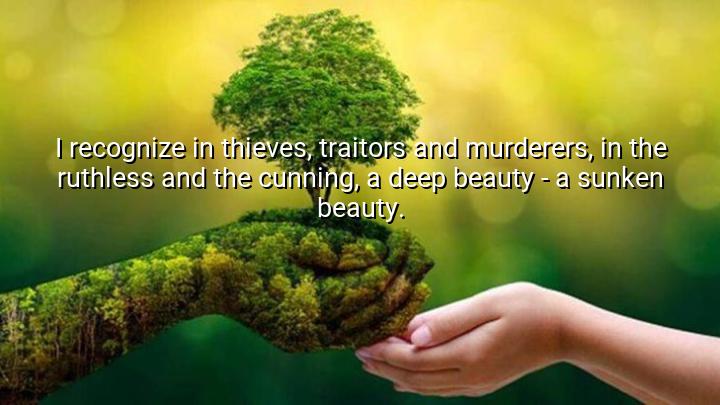




The quote "I recognize in thieves, traitors and murderers, in the ruthless and the cunning, a deep beauty - a sunken beauty" by Jean Genet explores the complex relationship between morality, beauty, and human nature. Genet, a French writer and playwright known for his exploration of marginalized figures and dark aspects of society, suggests that even in individuals who engage in heinous acts such as theft, betrayal, or murder, there exists a certain form of beauty. However, this beauty is not conventional or easily visible; it is described as "sunken," indicating that it is hidden beneath layers of immorality or corruption.
Genet’s reference to "sunken beauty" suggests that beauty can be found even in the most flawed and distorted aspects of human existence. He challenges the traditional notion that beauty is only associated with innocence, goodness, or purity. Instead, he presents a more complex, perhaps tragic, form of beauty that can be found in the darkness of human experience. This idea is reflective of his larger body of work, which often focused on outsiders, criminals, and revolutionaries who operate outside societal norms but still possess a form of inner, albeit distorted, humanity.
The quote also speaks to the duality of human nature, where even those who commit morally reprehensible acts are not purely evil but have a depth or complexity that can be seen as beautiful in its own way. Genet’s portrayal of these characters suggests that beauty is not just about external appearances but also about the internal, sometimes contradictory, forces that shape human actions. In his view, understanding the beauty within such individuals requires a more nuanced approach to human nature, one that acknowledges both light and darkness.
Ultimately, Genet’s words challenge traditional moral judgments and push the boundaries of how we define beauty and humanity. By recognizing a "sunken beauty" in the most ruthless and immoral characters, he invites readers to reflect on the complexities of human nature and the possibility of beauty existing even in the most unexpected places.

AAdministratorAdministrator
Welcome, honored guests. Please leave a comment, we will respond soon