

I never considered a difference of opinion in politics, in religion, in philosophy, as cause for withdrawing from a friend.
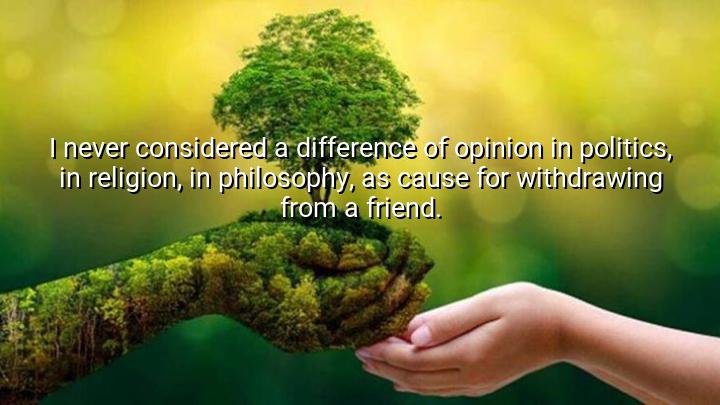




The quote "I never considered a difference of opinion in politics, in religion, in philosophy, as cause for withdrawing from a friend" by Thomas Jefferson reflects his belief in the importance of friendship and mutual respect despite differences in views. Jefferson, one of the Founding Fathers of the United States, valued personal relationships over ideological conformity, believing that such differences should not be a barrier to maintaining strong connections with others.
This quote suggests that Jefferson saw diversity of thought as a natural part of human interaction, especially in complex areas such as politics, religion, and philosophy. Rather than allowing disagreements to disrupt friendships, he believed in the strength of tolerance and the ability to accept others' perspectives without sacrificing personal bonds. This attitude reflects a broader principle of democracy where differing opinions are not only tolerated but are considered a healthy part of societal discourse.
The origin of this quote can be traced to Jefferson's personal correspondence, where he often expressed his belief in the value of intellectual freedom and the importance of understanding others’ viewpoints. In a time of deep political divisions, especially during the early years of the United States, Jefferson's outlook on friendship and differences of opinion was both progressive and insightful, aiming to preserve relationships in the face of contentious debates.
Ultimately, the quote serves as a reminder that friendships can endure and even thrive amidst divergent views. It encourages the idea that the essence of a friendship should be based on respect and the ability to embrace differing opinions, rather than letting those differences drive a wedge between people.

AAdministratorAdministrator
Welcome, honored guests. Please leave a comment, we will respond soon