

I love building spaces: architecture, furniture, all of it, probably more than fashion. The development procedure is more tactile. It's about space and form and it's something you can share with other people.
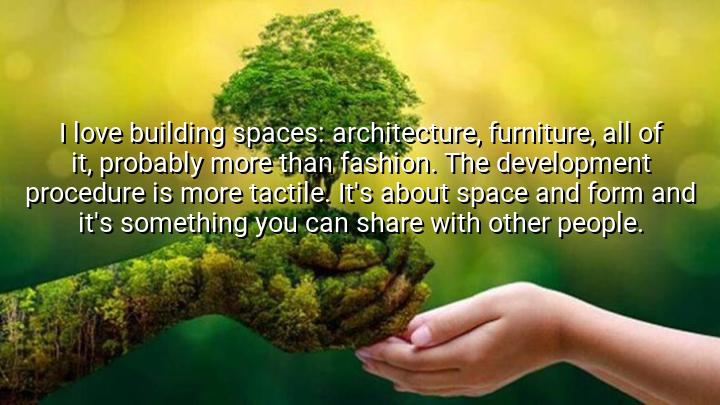




The quote by Donna Karan, "I love building spaces: architecture, furniture, all of it, probably more than fashion...," reveals her deep appreciation for design beyond the realm of fashion. Though widely known as a pioneering fashion designer, Karan expresses a passion for architecture, interior design, and furniture, emphasizing how these disciplines involve working with space and form in a tangible, tactile way. Her words suggest that, unlike fashion, which is often personal and fleeting, designing physical spaces offers a more enduring and shared experience.
Karan’s background in fashion naturally involves a sensitivity to shape, material, and structure, which translates easily into her interest in spatial design. By describing the process as more “tactile,” she highlights the hands-on, sensory nature of crafting environments—something that can be felt, touched, and inhabited. This physical connection to the design process creates a deeper, more immersive engagement with the materials and forms being shaped.
Her emphasis on sharing also speaks to the inherently communal nature of architecture and interior design. While a piece of clothing may be experienced individually, a space is something that people move through, gather in, and interact with collectively. For Karan, this makes the act of building spaces even more meaningful—it becomes a way to foster connection and enhance the lived experience of others.
Ultimately, this quote reflects Karan’s broader view of design as lifestyle—where fashion, architecture, and furniture are all expressions of the same creative impulse. It underscores the idea that beauty, functionality, and emotional resonance can exist across disciplines, and that thoughtful design—whether in clothing or space—can shape how we feel, move, and live.

THBui Thi Huong-8a1
There’s something poetic in the way Karan talks about development being tactile. I’d love to know what specific materials or processes she enjoys most—woodworking, layout planning, structural design? It’s refreshing to see a creative figure recognize that tactile, grounded process is as inspiring as high-concept aesthetics. Could this hands-on, immersive approach be a key reason why spatial design often evokes stronger emotional responses than fashion?
TDVU TIen Duc
I really appreciate the emphasis on sharing in this quote. Creating fashion can be very individual, but architecture and furniture naturally involve others—from engineers to occupants. Do you think this collaborative aspect makes space design more rewarding? I wonder if there's also a deeper sense of responsibility when creating something people will live in or interact with regularly.
HLNguyen Thi Huong Lan
This quote got me thinking: do you believe creating physical spaces gives designers a more lasting legacy than fashion? Spaces often hold memories, host relationships, and influence moods long-term. Fashion, while powerful, is more fleeting. Maybe that’s why designing a space feels more communal—you’re building something that others will inhabit and experience daily. Do you think more designers should view space as a canvas for storytelling?
TNtran nghi
I’m intrigued by the idea that space and form feel more tactile than fashion. Isn’t fabric equally tactile? Maybe the difference is in permanence—buildings and furniture stick around longer and can be experienced repeatedly by more people. Does that longevity add to the emotional satisfaction of creating them? I'd be curious how many fashion designers eventually shift into interiors or architecture because of this deeper connection.
TPThu trang Pham
This makes me reflect on how architecture and furniture design are inherently collaborative and communal in a way that fashion sometimes isn’t. A well-designed space invites people in, makes them feel something, and influences behavior. Do you think that’s why some creatives gravitate toward spatial design as they evolve? Maybe the ability to shape environments is more emotionally impactful than designing clothing.