

I longed to arrest all beauty that came before me, and at length the longing has been satisfied.
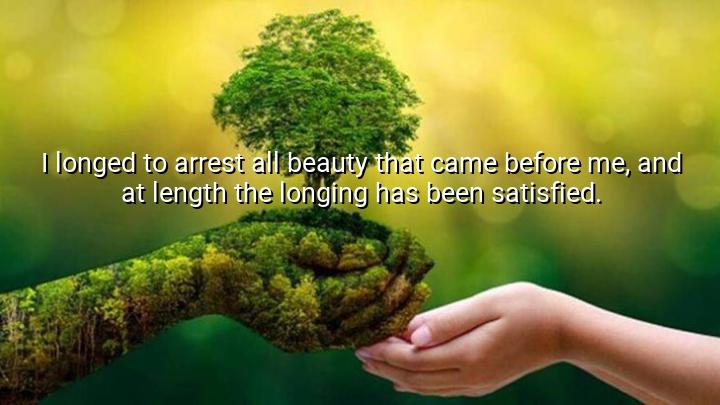




The quote "I longed to arrest all beauty that came before me, and at length the longing has been satisfied" by Julia Margaret Cameron reflects her deep desire to capture the essence of beauty through her art. Cameron, a pioneering photographer in the 19th century, is expressing how she yearned to preserve and immortalize moments of beauty in the world around her. The use of the word "arrest" suggests that she sought to halt time itself, freezing fleeting moments of beauty and emotion in her photographs for eternity.
Cameron’s statement also highlights the connection between her personal longing and her artistic practice. As a photographer, she saw her camera as a tool to fulfill her desire to capture beauty in its purest form. The idea of arresting beauty signifies her intention to control and preserve it, making it permanent rather than allowing it to fade away with time. This reflects the power of photography to capture emotions and images that might otherwise be lost, offering a sense of permanence to the ephemeral.
By saying, "at length the longing has been satisfied," Cameron suggests that over time, she found fulfillment in her work. Her photographs were not only artistic expressions but also a way for her to fulfill her own emotional and creative needs. Through her camera, she was able to create a lasting record of beauty, which in turn satisfied her desire to hold onto those moments.
Ultimately, Cameron’s quote speaks to the timeless relationship between art and the human need to preserve and reflect on the beauty we encounter. It underscores her belief in photography as a means of immortalizing moments of beauty, capturing the fleeting and making it eternal. This reflects her broader artistic philosophy and her legacy as one of the key figures in early photography.

AAdministratorAdministrator
Welcome, honored guests. Please leave a comment, we will respond soon