

I know that I shall meet my fate somewhere among the clouds above; those that I fight I do not hate, those that I guard I do not love.
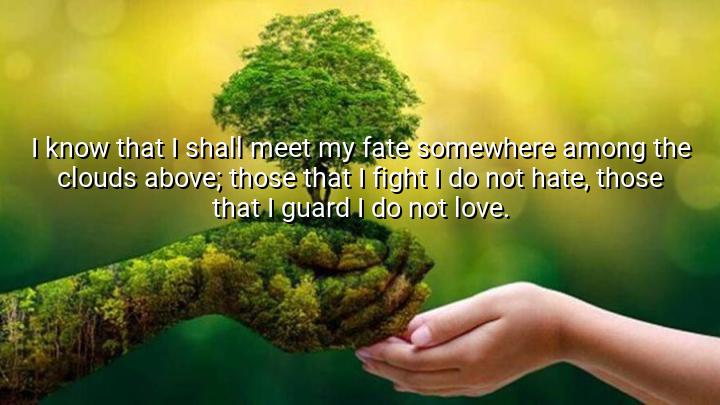




The quote "I know that I shall meet my fate somewhere among the clouds above; those that I fight I do not hate, those that I guard I do not love" by William Butler Yeats conveys a complex reflection on duty, fate, and the emotional distance between combat and allegiance. Yeats suggests that in the course of life, one may encounter their destiny or fate, often beyond the ground, symbolized by the clouds above. This could refer to the uncertainty and invisibility of what lies ahead, particularly in times of struggle or conflict. However, the key idea in the quote is the lack of personal emotion attached to the roles one plays, whether fighting or guarding. It emphasizes a sense of detachment from both sides of a conflict, which reflects a deeper philosophical stance.
Yeats states that those that I fight I do not hate, which implies that fighting does not necessarily arise from personal animosity. This suggests that conflict is often driven by external obligations or circumstances, rather than deep emotional investment. Similarly, the line those that I guard I do not love reinforces the idea that protection does not equate to personal affection. It conveys a sense of duty and responsibility rather than sentimental attachment. The emotional neutrality in both these actions emphasizes the distinction between personal feelings and public duty, where one's actions are governed by a higher purpose rather than individual emotions.
The origin of this quote is embedded in Yeats' poetic exploration of the complexities of human experience, particularly during times of war, political strife, and existential conflict. Yeats was deeply affected by the social and political turmoil in Ireland, and his works often reflect the tension between the individual’s emotional life and the broader, more detached roles they are called to play. His involvement in the Irish literary revival and his admiration for the idea of national identity was paralleled by his recognition of the complex, often ambiguous, nature of human action in times of conflict.
In essence, Yeats' quote speaks to the moral and emotional complexity of taking up arms or protecting others. It reveals a sense of resignation to the role one must play in the face of fate and duty, while maintaining a clear emotional detachment from the broader forces of love and hate. It suggests that one's actions are often dictated by larger, impersonal circumstances, rather than personal motivations or feelings. This captures the tension between individual emotion and the external duties imposed by life and circumstance.

AAdministratorAdministrator
Welcome, honored guests. Please leave a comment, we will respond soon